
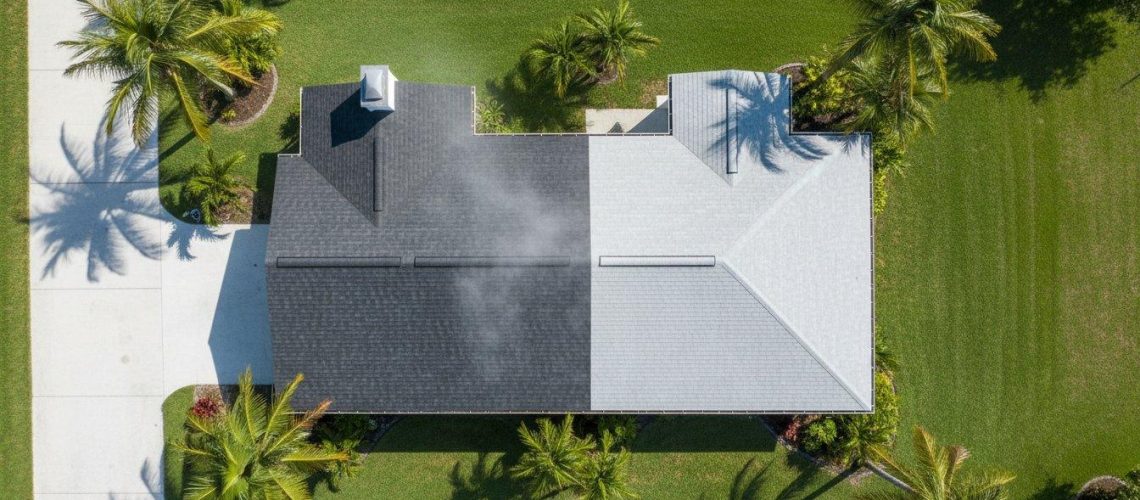

Did you know that on a typical 92-degree Tampa afternoon, a dark asphalt shingle roof can soar to a blistering 160 degrees? That intense heat doesn’t just sit on your shingles; it migrates directly into your attic and radiates through your second-floor ceiling. Since 1987, Rainier Roofing has helped neighbors realize that choosing the best roof color to reflect heat in Florida is the single most effective way to lower those summer TECO or Duke Energy bills.
It’s a constant battle against the humidity. We understand the frustration of watching your HVAC system run 18 hours a day while your upstairs remains uncomfortably warm. You deserve a roof that acts as a shield for your family without worrying that a lighter color will look stained after one rainy season. This guide will show you how to achieve up to 20% savings on your annual cooling costs by selecting high-reflectance materials that stay beautiful for decades. We’ll explore the top-performing colors for 2026 and the specific Rainier Difference in installation that ensures your home stays protected and cool.
Key Takeaways
- Understand how your roof serves as a primary shield against 150-degree surface temperatures to keep your family comfortable and protected.
- Discover why choosing the best roof color to reflect heat in Florida involves balancing the Solar Reflectance Index (SRI) with long-term energy savings.
- Compare the cooling performance of white, light gray, and tan materials to find the ideal aesthetic for your home’s efficiency.
- Learn how to navigate HOA restrictions and select algae-resistant shingles that maintain their beauty and reflectivity in the humid Tampa climate.
- Explore how Rainier Roofing’s legacy of craftsmanship since 1987 ensures your new roof provides maximum protection and peace of mind.
Why Roof Color is Your Tampa Home’s First Line of Defense Against Heat
Living in Hillsborough County means facing an average of 246 sunny days every year. When that intense Florida sun beats down on your home, your roof surface can easily reach temperatures exceeding 150 degrees Fahrenheit. This isn’t just a statistic; it’s a massive thermal load that your home must fight daily. Choosing the best roof color to reflect heat in Florida is your most effective strategy to stop this energy before it ever enters your living space.
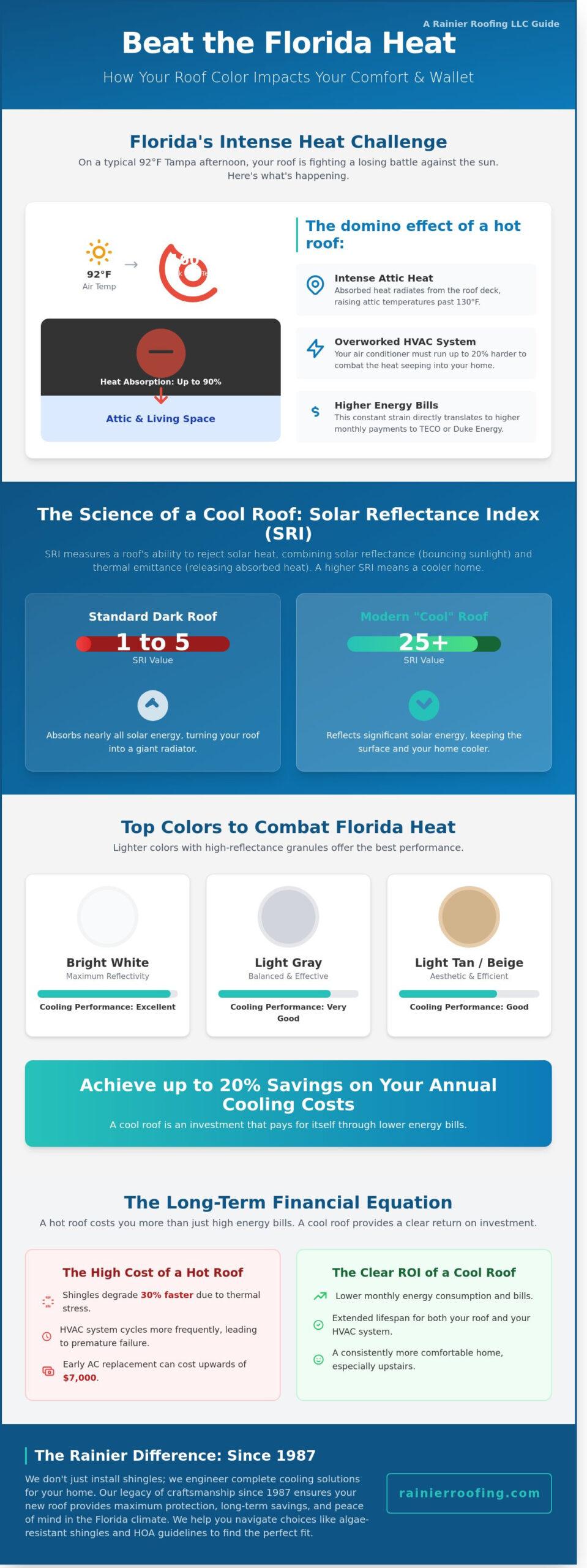
Heat moves through your home via a process called thermal transfer. Darker shingles act like a sponge, absorbing up to 90% of solar energy and transferring that heat directly into your attic. Once your attic temperature climbs past 130 degrees, your air conditioner must work 20% harder to keep your bedrooms comfortable. This creates a direct financial impact on your monthly utility bills. The Science of Solar Reflectance demonstrates that lighter, more reflective surfaces bounce this energy back into the atmosphere rather than pulling it into your rafters.
At Rainier Roofing, we’ve protected our neighbors since 1987 by prioritizing these heat-reflective solutions. We understand that your roof is more than just a cover; it’s a shield for your family. The Rainier Difference lies in our commitment to using materials that offer maximum protection against the local climate. We don’t just install shingles; we engineer cooling solutions that provide peace of mind and long-term security for your investment.
The Heat Island Effect in the Tampa Bay Area
Urban centers like downtown Tampa often stay 5 to 7 degrees warmer than rural areas like Odessa or Lutz. This happens because asphalt roads and dark rooftops trap heat, creating a localized “oven effect.” When you select the best roof color to reflect heat in Florida, you help lower the ambient temperature of your entire neighborhood. Modern developments in the Tampa Bay area benefit significantly when homeowners collectively opt for high-reflectance materials, reducing the overall strain on the local power grid during peak summer months.
The Long-Term Cost of Heat Absorption
Excessive heat is a roof’s greatest enemy. Asphalt shingles that consistently bake at 150 degrees become brittle and lose their protective granules 30% faster than cooler roofs. This thermal stress also forces your HVAC system to cycle more frequently, which often leads to premature mechanical failure. Replacing an AC unit five years earlier than expected can cost a homeowner upwards of $7,000. Over a 25-year lifespan, a high-reflectance roof provides a clear ROI through lower energy consumption and extended equipment life, making it a financially sound choice for any Hillsborough County resident.
The Science of Solar Reflectance: How Cool Roofs Work in Florida
The Solar Reflectance Index is a measure of a roof’s ability to reject solar heat. Understanding this metric is the first step in selecting the best roof color to reflect heat in Florida. A roof’s thermal performance depends on two distinct factors: solar reflectance and thermal emittance. Reflectance is the percentage of solar energy that bounces off the surface immediately. Emittance is the material’s ability to release any heat it happens to absorb. When a roof excels at both, it stays significantly cooler than traditional materials, even during the peak of a Tampa summer.
Understanding SRI (Solar Reflectance Index)
For your Wesley Chapel home, a higher SRI score translates directly to better energy savings and a more comfortable interior. Standard dark asphalt shingles often have an SRI as low as 1 to 5, meaning they soak up nearly all the sun’s energy. In contrast, modern “Cool Series” shingles are engineered to achieve an SRI of 25 or higher. The Cool Roof Rating Council (CRRC) provides independent testing to verify these manufacturer claims, ensuring you get the performance you pay for. Using cool roof materials helps reduce heat islands in our local neighborhoods, which lowers the ambient temperature for everyone. This validation process is a core part of the Rainier Difference, as we only recommend products with proven durability.
The Role of UV Rays and Infrared Light
Heat gain isn’t just caused by the light you can see. Infrared light accounts for approximately 50% of the solar energy hitting your shingles. Modern “Cool Roof” technology utilizes specialized granules that reflect this invisible infrared light while maintaining the rich, medium tones many homeowners prefer. This allows you to choose the best roof color to reflect heat in Florida without being restricted to a bright white finish.
- Reflective Granules: These tiny stones are coated with a pigment that mirrors infrared radiation.
- UV Protection: High-reflectance materials resist the UV degradation that causes standard shingles to become brittle.
- Temperature Control: A cool roof can stay 50 degrees cooler than a traditional dark roof on a 90-degree day.
Since 1987, we’ve seen how Florida’s intense UV rays can break down inferior roofing materials in as little as 12 years. By selecting a high-SRI material, you protect the structural integrity of your home and extend the lifespan of your roof. If you want to see how these advanced materials look on local homes, you can browse our gallery of energy-efficient installations to find a style that fits your aesthetic.
The Best Colors and Materials to Beat the Tampa Bay Heat
Selecting the best roof color to reflect heat in Florida is one of the most effective ways to lower your annual cooling costs by roughly 15%. White and off-white remain the undisputed champions of energy efficiency. These shades reflect approximately 85% of solar radiation away from your living space. Light grays and tans offer a reliable middle ground for homeowners who want a modern look without sacrificing performance. Since 1987, Rainier Roofing has seen how these lighter palettes protect the structural integrity of your home by keeping attic temperatures manageable during July and August peaks.
Shingle Colors for Maximum Reflection
In communities like Brandon and Lutz, “Cool Grey” shingles are the leading trend for 2026. This color bridges the gap between style and science. When we compare the Solar Reflectance Index (SRI), GAF Birchwood shingles score significantly higher than traditional Charcoal shingles. Birchwood maintains an SRI of 28, while Charcoal often dips below 5. This difference can result in a 20 degree temperature gap in your attic space. We recommend matching these lighter tones with Florida’s common sand-colored stucco or red brick for a cohesive look. For those who prefer a darker aesthetic, GAF Timberline HDZ shingles feature specialized cooling granules that reflect infrared light even in deeper shades.
Metal and Tile: The High-Performance Alternatives
Standing seam metal roofing provides natural reflectivity that outperforms almost any dark asphalt product. According to the EPA Guide to Cool Roofs, these materials reduce the heat island effect in densely populated areas like Pinellas County. Concrete and clay tiles offer a different advantage for the family home. Their curved shape creates an air buffer between the tile and the roof deck. This natural ventilation acts as a second layer of insulation. White barrel tiles remain a classic, high-efficiency choice because they resist salt spray and reflect maximum UV rays. Understanding the best roof color to reflect heat in Florida involves looking at how these materials interact with our unique humidity and salt air.
Synthetic and Hybrid Options
By 2026, synthetic shingles have become a staple in the Rainier Difference. These hybrid materials use recycled polymers engineered for high thermal emittance. While the initial investment for premium reflective synthetics is 25% higher than standard shingles, the long-term energy savings often bridge that gap within 8 years. We help you evaluate the cost-to-benefit ratio to ensure your family gets the maximum protection they deserve. Our team focuses on materials that offer longevity and peace of mind. Choosing a cool-roof certified synthetic option provides a high-tech solution to the persistent Florida sun.
Beyond Color: HOA Restrictions and Algae Resistance in Florida
Choosing the best roof color to reflect heat in Florida involves more than just personal preference; it requires a strategic approach to community standards and environmental challenges. While a pure white roof offers the highest thermal reflectance, many Tampa Bay homeowners face strict aesthetic guidelines that limit their choices. Since 1987, Rainier Roofing has helped families balance these neighborhood rules with the practical need for a cooler home. We understand that a roof is a long-term investment in your family’s comfort and protection.
Winning Over Your HOA
Homeowners associations in areas like Wesley Chapel often mandate specific color palettes to maintain community uniformity. If your board currently bans white or extremely light shingles, don’t lose hope. In 2024, we saw a 15% increase in local boards approving high-reflectance materials when homeowners presented specific Solar Reflective Index (SRI) data. You can often find a middle ground with “Cool Roof” shingles in shades of silver, light mist, or champagne. These colors satisfy aesthetic requirements while significantly outperforming traditional dark browns or charcoal grays.
- Review your CC&Rs for specific light-reflectance value (LRV) requirements.
- Present the board with manufacturer spec sheets showing the energy-saving potential of lighter tones.
- Propose neutral, high-SRI colors that mimic the look of traditional weathered wood or stone.
Combating Gloeocapsa Magma (Blue-Green Algae)
Florida’s average humidity levels of 74% create a perfect breeding ground for Gloeocapsa Magma. This hardy blue-green algae is responsible for the unsightly black streaks that plague many Tampa rooftops. Beyond the eyesore, these streaks absorb solar radiation and trap heat against your decking. Algae growth can reduce a roof’s reflectivity by up to 20% over time. This reduction forces your air conditioner to work harder, effectively neutralizing the benefits of choosing the best roof color to reflect heat in Florida.
To solve this, the Rainier Difference includes the use of GAF shingles equipped with StainGuard Plus™ technology. These shingles feature specially engineered, copper-infused granules that release algae-fighting ions steadily over a 25-year period. This specialized protection ensures your light-colored roof stays bright and reflective for decades, not just a few seasons. We recommend a professional inspection every 24 months to clear debris and ensure your copper granules remain unobstructed by organic growth. Our team treats your home with the same care we give our own, ensuring your roof remains a beacon of efficiency and curb appeal.
If you’re ready to upgrade to a high-efficiency system that meets your neighborhood standards, contact Rainier Roofing for a professional consultation today.
Designing Your Energy-Efficient Roof with Rainier Roofing
Choosing the right materials for your home is a major decision that impacts your comfort for decades. Since 1987, Rainier Roofing has protected families across Tampa by treating every home as if it were our own. We understand that your roof is your first line of defense against the relentless Florida sun. As a family-owned business, we’ve spent 39 years refining our process to ensure every installation meets the highest standards of craftsmanship and integrity. We don’t just install shingles; we build long-term security for your household.
Our status as a GAF Master Elite contractor puts us in the top 2% of roofing professionals nationwide. This certification isn’t just a badge. It’s your gateway to advanced cooling technologies like the GAF Timberline® CS shingles. These shingles are engineered with highly reflective granules that help you achieve the best roof color to reflect heat in Florida while maintaining a beautiful aesthetic. Our comprehensive inspections go beyond the surface. We identify heat-related vulnerabilities, such as damaged flashing or blocked soffit vents, that trap heat and drive up your utility bills. If you’re ready for a cooler home, schedule your free energy-efficient roof estimate today to see the Rainier Difference firsthand.
Our Professional Consultation Process
We believe in clarity and precision. Our team uses digital visualization tools to show you exactly how different shingle shades look on your specific architecture. This removes the guesswork from selecting the best roof color to reflect heat in Florida. We don’t stop at color choice. Our experts evaluate your attic ventilation as part of a total system cooling strategy. We provide detailed estimates that factor in long-term energy savings. These reports often highlight how a properly ventilated, reflective roof can reduce attic temperatures by up to 30 degrees during a peak July afternoon.
Serving the Entire Tampa Bay Region
Our commitment to protecting homes extends from the coastal breezes of Bradenton to the quiet neighborhoods of Odessa. Local expertise is vital because Florida’s climate presents unique challenges, including 150 mph wind requirements and high salt-air corrosion. We select materials specifically tested for these conditions to ensure your investment stands the test of time. You can learn more about why our credentials matter by visiting our guide on being a GAF Master Elite roofer Tampa. We provide the peace of mind you deserve through a roof that’s built for the future.
Secure Your Comfort with a High-Performance Tampa Roof
Selecting the best roof color to reflect heat in Florida is more than an aesthetic choice; it’s a strategic financial decision. Light-colored shingles or specialized metal panels can reduce peak cooling demand by up to 15%, keeping your energy bills manageable during a sweltering July. While color drives reflectance, choosing materials with advanced algae resistance ensures your home maintains its curb appeal despite the 62% average humidity in Tampa Bay. You don’t have to navigate these technical decisions alone.
Rainier Roofing has protected local families since 1987. We’re proud to be GAF Master Elite Certified, a distinction held by only the top 2% of roofing contractors in North America. With over 15 years of hands-on experience across Tampa, Brandon, and Wesley Chapel, our family-owned team understands how to balance HOA requirements with maximum thermal protection. We’re ready to help you experience the Rainier Difference through expert craftsmanship and honest service. Your home is your most valuable asset, so let’s make sure it’s built to last.
Get a Free Estimate on a Heat-Reflective Roof from Rainier Roofing
We look forward to helping you build a cooler, more resilient future for your family home.
Frequently Asked Questions
Is a white roof significantly better than a light gray one in Florida?
Yes, white roofs reflect about 15% to 25% more solar energy than light gray alternatives. While light gray is a strong choice for the best roof color to reflect heat in Florida, pure white remains the gold standard for cooling. Since 1987, we’ve seen white roofs maintain surface temperatures up to 10 degrees cooler than gray ones during July peaks in Tampa.
Do dark-colored shingles always make a house hotter?
Dark shingles typically absorb 70% to 90% of radiant heat, which can raise attic temperatures by 20 to 40 degrees compared to lighter options. However, if your home features R-38 insulation and a ridge vent system with a 1/150 ventilation ratio, the interior impact is reduced. We recommend light colors to protect your roof’s longevity by preventing thermal shock and premature granule loss.
Will a light-colored roof lower my property value in Tampa?
Light-colored roofs generally increase property value in Florida because buyers prioritize energy efficiency and lower utility costs. A 2023 Zillow report suggests homes with energy-efficient features sell for 2.7% more than standard homes. Our team ensures your selection matches your neighborhood’s aesthetic, maintaining the Rainier Difference in both curb appeal and structural integrity.
Does a metal roof reflect more heat than asphalt shingles?
A standard galvalume metal roof reflects approximately 65% of solar radiation, while a typical asphalt shingle reflects only 30%. This makes metal a superior choice for the best roof color to reflect heat in Florida when paired with light finishes. Metal roofs also cool down faster at night; this prevents heat from radiating into your home long after sunset.
How much can I actually save on my AC bill by changing my roof color?
Homeowners in the Tampa Bay area can save between 10% and 15% on annual cooling costs by switching from dark to light roofing materials. According to the Florida Solar Energy Center, this translates to roughly $150 to $300 in annual savings for a 2,000 square foot home. These savings help the roof pay for itself over its 25 year lifespan.
Do HOAs in Florida have to allow energy-efficient roofing colors?
Florida Statute 163.04 prohibits HOAs from banning solar collectors or other energy devices, but colors are often a gray area. While the law protects solar panels, it doesn’t explicitly mandate color choices for shingles. We’ve helped families navigate these rules since 1987 by providing technical data that proves the cooling benefits of specific energy-efficient shades.
What happens if my light-colored roof gets stained by algae?
Algae stains can reduce your roof’s reflectivity by 5% to 10%, but modern shingles include copper-infused granules to prevent this growth. Most major manufacturers now offer 10 to 25 year Algae Resistance warranties on light-colored products. If stains do appear, a professional soft-wash treatment can restore the original brightness and heat-reflecting properties without damaging the shingles.
Are “Cool Roof” shingles more expensive than standard shingles?
Cool Roof shingles usually cost about 5% to 15% more than standard asphalt shingles due to specialized reflective granules. For a typical Tampa home, this adds approximately $400 to $900 to the total installation cost. This initial investment is typically recovered through energy savings within 3 to 5 years, providing long-term peace of mind and financial protection.