
What if the lowest quote you receive today actually costs you $28,000 in uninsurable damage during the next major storm? In a state where wind speeds reach 150 mph, choosing a partner based on price alone is a gamble your family shouldn’t take. You likely worry about “fly-by-night” contractors who disappear with your deposit. It’s a valid fear. Knowing the right questions to ask a roofing contractor in Florida is the only way to separate local craftsmen from temporary crews who ignore the 8th Edition of the Florida Building Code.
We understand that protecting your home feels like a heavy responsibility. This is especially true since insurance companies can require inspections on any roof 15 years or older. This guide helps you master the vetting process. You’ll learn how to secure a roof that earns maximum warranty protection and qualifies for the $280 million My Safe Florida Home grant program. We’ll walk through the credentials and financial stability markers you need to find a professional who will stand by their work long after the clouds clear.
Key Takeaways
- Learn why choosing a local expert is the only way to navigate Florida’s strict 8th Edition building codes and high humidity levels.
- Master the legal questions to ask a roofing contractor in Florida to verify their DBPR license and full insurance coverage before signing any contract.
- Understand the technical benefits of a full tear-off and GAF Timberline HDZ shingles to ensure your roof withstands 150 mph winds.
- Identify how to secure fixed-price estimates and fair payment terms that protect you from hidden fees and “fly-by-night” deposit scams.
- Discover how elite manufacturer certifications provide the long-term warranty protection needed to keep your home storm-ready for years to come.
Why Vetting a Florida Roofer Requires a Specialized Approach
Florida isn’t like other states. The relentless combination of 100-degree heat and 150 mph hurricane winds creates a brutal environment for any structure. Your roof is your home’s primary shield, yet it’s also the most vulnerable to our tropical climate. Since December 31, 2023, all roofing work must comply with the 8th Edition of the Florida Building Code. These are the strictest standards in the country. When you begin your search, the most critical questions to ask a roofing contractor in Florida center on their ability to meet these evolving requirements. A local professional acts as a guardian for your home, ensuring that every nail and sealant strip is prepared for the next storm season.
Out-of-state “storm chasers” often flood the Tampa Bay area after a major hurricane. These contractors lack a long-term commitment to our community. They might offer a low price, but they rarely understand the nuances of local enforcement or the long-term effects of 90% humidity on an Asphalt shingle system. If a problem arises two years later, these companies are often long gone, leaving your warranty worthless. A local roofer who has stood the test of time since 1987 provides the stability you need for true peace of mind.
The Reality of the Florida Roofing Market
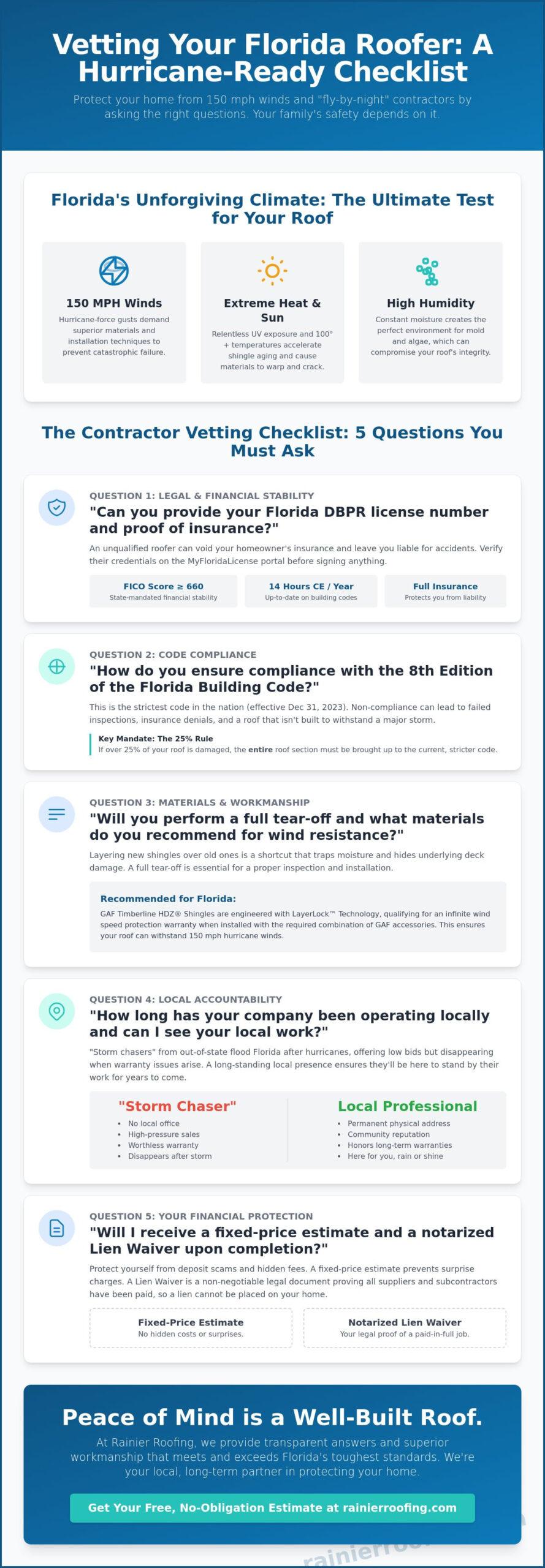
Florida mandates that certified roofing contractors maintain a FICO credit score of at least 660 and complete 14 hours of continuing education every year. These rules exist to protect you from “tailgate” contractors who lack the financial stability to honor their commitments. In cities like Tampa and Brandon, unlicensed labor is a significant risk that can lead to failed inspections and insurance denials. Your contractor must demonstrate a deep understanding of wind resistance ratings, which often range from 130 to 150 mph in coastal zones. If they don’t have a proven track record with the Florida Department of Business and Professional Regulation, they aren’t qualified to protect your family.
Defining Your Goals Before the Interview
You must decide if you need a targeted repair or a full system replacement before you start vetting. If more than 25% of your roof’s area is damaged within a 12-month period, the “25% Rule” usually requires the entire roof to be brought up to current code. This is where the questions to ask a roofing contractor in Florida become vital. You need a consultative partner who explains these legal nuances rather than a high-pressure salesperson. Whether your priority is the maximum durability of standing seam metal or the impact resistance of GAF Timberline HDZ shingles, your contractor should focus on your home’s long-term security. They should help you identify a solution that balances aesthetics with the structural integrity required to survive a Category 4 hurricane.
Essential Legal and Insurance Questions for Florida Compliance
Legitimacy in the Florida roofing market isn’t a suggestion; it’s a legal requirement that protects your financial future. Your homeowner’s insurance policy often hinges on the legality of your roof installation. If you hire an unlicensed or under-insured crew, you risk losing coverage and facing personal liability for on-site accidents. When preparing your list of questions to ask a roofing contractor in Florida, start with their credentials. A qualified professional should immediately provide a Florida DBPR license number that you can verify in seconds. This number proves the contractor maintains a FICO credit score of 660 or higher and completes 14 hours of continuing education every year to stay current with the 8th Edition of the Florida Building Code.
A notarized Lien Waiver is another non-negotiable document you must request before making a final payment. This document confirms that all material suppliers and subcontractors have been paid in full. Without it, a supplier could legally place a lien on your home even if you paid your contractor every cent. For additional guidance on professional standards, you can review FRSA consumer resources to understand the safeguards put in place by the Florida Roofing and Sheet Metal Contractors Association. At Rainier Roofing, we provide these documents as a standard part of our process because we believe in neighborly trust and total transparency.
Verifying the Florida License (DBPR)
Always use the MyFloridaLicense portal to check for active complaints or recent suspensions. In Florida, a “Certified” contractor can work anywhere in the state, while a “Registered” contractor is limited to specific local jurisdictions. You should never hire a roofer who asks you to pull an “owner-builder” permit. This is a major red flag. It shifts all legal and safety responsibility from the contractor to you, making you the person liable for code violations or worker injuries. A reputable guardian of your home will handle all permitting and inspections personally.
The Insurance Loophole You Must Avoid
Many small crews claim “exempt” status for Workers’ Compensation to lower their overhead. This puts you at massive financial risk. If a worker is injured on your property and the contractor is exempt, you could be held responsible for their medical bills. Despite Workers’ Comp rates for roofing dropping by 11.04% for 2026, some contractors still cut corners. Always demand a Certificate of Insurance (COI) sent directly from the insurance agent to your email. We maintain high-limit liability coverage because we understand that protecting your property during a tear-off requires more than the state-mandated $100,000 minimum.
Technical Questions About Materials and Hurricane-Ready Workmanship
Technical questions bridge the gap between a signed contract and a roof that survives a Category 4 hurricane. While the 8th Edition of the Florida Building Code provides the legal framework, your contractor’s daily habits determine your home’s longevity. One of the primary technical questions to ask a roofing contractor in Florida is whether they perform a full “tear-off” or a “roof-over.” In Florida, a roof-over is often a recipe for disaster; it traps heat and prevents a proper inspection of the roof deck. A full tear-off allows us to identify and replace damaged plywood before it compromises your home’s structural integrity. We always perform a full deck inspection to ensure every sheet of wood is fastened to current wind-uplift standards.
We recommend GAF Timberline HDZ shingles because they utilize LayerLock technology. This creates the industry’s widest nailing zone, which is essential for achieving wind-speed coverage. As a GAF Master Elite contractor, we belong to the top 2% of roofers in North America. This certification isn’t just a badge; it’s your assurance that our team has the specialized training to handle Florida’s extreme thermal expansion. Before you sign, verify their credentials through the Florida DBPR license verification portal to ensure their standing is current. You should also ask about the secondary water barrier (SWB). Most insurers now require a self-adhered polymer-modified bitumen membrane to provide maximum protection against water intrusion if shingles are lost during a storm.
Workmanship Standards for the Tampa Bay Climate
Precision matters when winds reach 150 mph. We utilize a 6-nail pattern for every shingle rather than the standard 4-nail approach to ensure maximum uplift resistance. We also replace all flashing and drip edges rather than taking the “re-use” trap that often leads to slow leaks. Proper attic ventilation is equally vital. Without balanced intake and exhaust systems, Florida’s 95-degree heat will “cook” your shingles from the inside out, causing premature granule loss and curling. Our team ensures your ventilation meets the 1:150 ratio required for long-term material health.
The Crew and On-Site Management
Your installation is only as good as the people on your roof. You should include the crew’s background in your questions to ask a roofing contractor in Florida. Are the installers factory-trained employees or temporary sub-contractors? We utilize dedicated project managers on every site to oversee the Rainier Difference in real-time. This includes protecting your property. We use specialized equipment to shield your landscaping and pool during the demolition phase, ensuring that the only sign we were there is your beautiful new roof. We treat your family home with the same respect we would our own.
Business Logistics: Estimates, Warranties, and Local Accountability
Reliability is the bedrock of the Rainier Difference. Once you understand the technical needs of your roof, you must evaluate the business standing of your potential partner. The logistics of your contract are just as important as the shingles themselves. When finalizing your list of questions to ask a roofing contractor in Florida, focus on financial transparency and long-term accountability. A trustworthy local roofer will never hesitate to provide a fixed-price estimate that accounts for the 8th Edition of the Florida Building Code and necessary permit fees. We’ve seen many homeowners blindsided by “unforeseen” costs; we prevent this by providing clear, itemized proposals from the start.
Ask specifically how the contractor handles wood rot. In Florida’s humid climate, discovering soft decking during a tear-off is common. We include a specific per-sheet price for plywood replacement in our initial proposals so you aren’t surprised by the final bill. Regarding payment, you should be cautious of any company demanding a massive deposit before materials arrive at your home. Since 1987, we’ve maintained a physical office in the Tampa Bay area. This local roots approach ensures we are here to answer for our workmanship years after the job is done. A “storm chaser” with a P.O. box cannot offer that same sense of neighborly trust.
You must also understand the gap between a manufacturer’s warranty and a workmanship warranty. While GAF covers material defects for decades, a workmanship warranty covers the actual installation. If a leak occurs because of a flashing error, you need to know your contractor will return to fix it without sending you a bill. We stand behind our craftsmanship because we view ourselves as guardians of your family home.
Decoding the Roofing Estimate
A professional proposal should be itemized and detailed. It must include debris removal, skylight replacement if necessary, and specific material brands like GAF Timberline HDZ. Beware of contractors offering to “waive” your insurance deductible. This practice is illegal under Florida law and constitutes insurance fraud. A reputable partner will always operate within legal boundaries to protect your property and your insurance standing. If you want a transparent, no-pressure evaluation of your home’s needs, schedule your detailed roof consultation today.
Post-Job Accountability and Safety
The work doesn’t end when the last shingle is nailed. We perform a comprehensive “Magnetic Sweep” of your driveway and yard to collect every stray nail, protecting your tires and your family’s safety. This is a common pain point that many generic guides overlook. Before you make your final payment, a supervisor should walk the roof with you to ensure every detail meets our standards of integrity. If you experience an emergency leak within the first year, you need a partner who responds with a calm, rhythmic assurance rather than a busy signal.
The Rainier Difference: Why Our Answers Give You Peace of Mind
Vetting a contractor is about more than just checking boxes; it is about finding a guardian for your home. When you prepare your final list of questions to ask a roofing contractor in Florida, you deserve answers that reflect both technical mastery and local accountability. We have served the Tampa Bay area, including Brandon and Wesley Chapel, with a commitment to neighborly trust that began in 1987. This long-standing history means we understand the specific humidity and wind challenges of our region better than any out-of-state crew. We treat every project as a long-term commitment to our community’s safety.
Our family-owned operation prioritizes integrity over high-pressure sales tactics. We recognize that a new roof is a significant investment, often ranging from $18,000 to $32,000 for Florida homeowners in 2026. Because we value your peace of mind, we provide a consultative experience that simplifies the complex interplay between the 8th Edition of the Florida Building Code and your insurance requirements. We don’t just install shingles; we build storm-ready systems designed to provide maximum protection for your family.
Certified Protection for Your Largest Investment
Our status as a GAF Master Elite Roofer Tampa puts us in the top 2% of contractors in North America. This elite certification is a signature of stability that allows us to offer the Golden Pledge® Limited Warranty. This is the highest level of manufacturer protection available, covering both materials and workmanship. If you want a roof that truly stands up to 150 mph winds, you need a team that manufacturer experts have vetted personally. Since 1987, we have maintained these rigorous standards to ensure our craftsmanship remains a benchmark for the industry.
Next Steps: Getting Your Free Professional Estimate
Choosing a partner for your home shouldn’t feel stressful. We provide a methodical inspection process that identifies potential issues before they become emergencies. During a Rainier Roofing professional inspection, we examine every component from the seamless gutters to the attic ventilation. We then provide a fixed-price proposal that eliminates the fear of hidden fees or “unforeseen” wood rot costs. Our team handles the documentation required for the $280 million My Safe Florida Home grant program, helping you maximize your savings while hardening your home.
If you are ready to secure your home before the next storm season, learning How to Choose the Best Roofing Company in Tampa is your first step toward total security. We invite you to contact our team for a no-obligation consultation today. We will answer all your questions to ask a roofing contractor in Florida with the transparency and professionalism we have provided for nearly 40 years. Your home deserves the Rainier Difference.
Take Control of Your Home’s Storm Protection
Vetting a roofer in our unique climate is about more than just checking boxes. It is about ensuring your family is protected against the next 150 mph hurricane winds. You now have the tools to verify 8th Edition code compliance and identify local experts who will stand by their warranties. By mastering these questions to ask a roofing contractor in Florida, you move from feeling overwhelmed to feeling confident in your home’s structural integrity.
We’ve protected Tampa Bay homes since 1987 with a commitment to craftsmanship that has earned us an A+ BBB rating and hundreds of 5-star local reviews. As a GAF Master Elite contractor, we belong to the top 2% of roofing professionals nationwide. This elite status allows us to offer superior warranty protection that generic crews simply cannot match. We treat your property with the neighborly trust it deserves, acting as guardians of your largest investment. Schedule your free, no-pressure roofing inspection with Rainier Roofing today! Your peace of mind is our priority, and we look forward to helping you build a storm-ready future.
Frequently Asked Questions
Is it a red flag if a Florida roofer asks for a 50% deposit upfront?
Yes, a 50% deposit is a major red flag that suggests a contractor lacks the financial stability to purchase materials or pay their labor. Reputable Florida roofers typically require between 10% and 33% as a down payment to secure your spot on the schedule. If a contractor demands half the total cost before a single shingle arrives, they may be using your funds to finish a previous project. Always prioritize partners with the liquidity to manage their own overhead.
How can I verify if a roofing contractor is actually GAF Master Elite certified?
You can verify this status by using the “Certified Contractor” locator tool on the official GAF website. Simply enter the company’s name or zip code to see their current standing. Only 2% of contractors nationwide hold this elite certification, which requires rigorous background checks and ongoing training. This verification is one of the most important questions to ask a roofing contractor in Florida to ensure you receive the highest level of warranty protection.
Do I need to be home during the roofing installation process?
You don’t need to be home during the installation, but we recommend being available by phone for quick decisions. Our crews are self-sufficient and only require access to an outdoor power outlet and a water spigot. If we discover structural issues during the tear-off, having you nearby allows for an immediate consultation. We provide a dedicated project manager to handle all on-site logistics so you can go about your day with peace of mind.
What happens if a roofer finds rotten wood after they’ve already started the tear-off?
If we find rotten wood, we immediately document the damage with photos and notify you before proceeding. We replace the compromised decking according to the per-sheet price established in your original contract. This ensures your new roof has a solid foundation that meets the 8th Edition of the Florida Building Code. We never cover up wood rot because doing so would compromise your home’s structural integrity and wind resistance during a hurricane.
Can a roofing contractor help me with my insurance claim in Florida?
A roofing contractor can provide a detailed damage assessment and meet with your insurance adjuster to point out technical deficiencies. However, Florida law prohibits contractors from acting as public adjusters or negotiating settlements on your behalf. We focus on providing the technical documentation your carrier needs to process the claim accurately. This professional approach protects you from the legal risks associated with unauthorized public adjusting while ensuring your roof meets current safety standards.
How long does a typical roof replacement take in the Tampa area?
Most roof replacements for a standard-sized home in the Tampa area take between 1 and 3 days to complete. Factors like the roof’s pitch, the complexity of the design, and the specific material chosen can influence this timeline. While summer rain showers are common, our crews are trained in emergency tarping to protect your home during the process. We work methodically to ensure your project is finished efficiently without sacrificing the craftsmanship your family depends on.
What is a ‘Lien Waiver’ and why do I need one from my roofing company?
A Lien Waiver is a legal document that confirms your contractor has paid all material suppliers and subcontractors in full. You need this to protect yourself from “double payment” scenarios. If a contractor fails to pay their shingle supplier, that supplier can place a lien on your home even if you’ve paid your roofer. We provide notarized waivers as a standard part of our closing process to ensure your total financial security and peace of mind.
Does Florida law require roofers to replace the drip edge during a re-roof?
Yes, the 8th Edition of the Florida Building Code mandates that a new drip edge must be installed during any roof replacement. This metal flashing prevents water from seeping under the shingles and damaging the fascia or roof deck. Some “tailgate” contractors try to cut costs by reusing old, rusted metal, but this is a code violation. Including this in your list of questions to ask a roofing contractor in Florida ensures your roof remains fully compliant and storm-ready.