
In Brandon, a “storm chaser” can look exactly like a professional contractor until the first hurricane wind hits your new shingles. You’ve worked hard to build a life here in the Tampa Bay area; the thought of a “tailgate contractor” disappearing with your deposit is enough to keep any homeowner awake at night. It’s completely normal to feel anxious about whether an estimate is a fair deal or a financial trap, especially when Florida roofing regulations seem to shift constantly. Learning the red flags when hiring a roofer Brandon homeowners should watch for is the first step in securing your family’s safety and your investment.
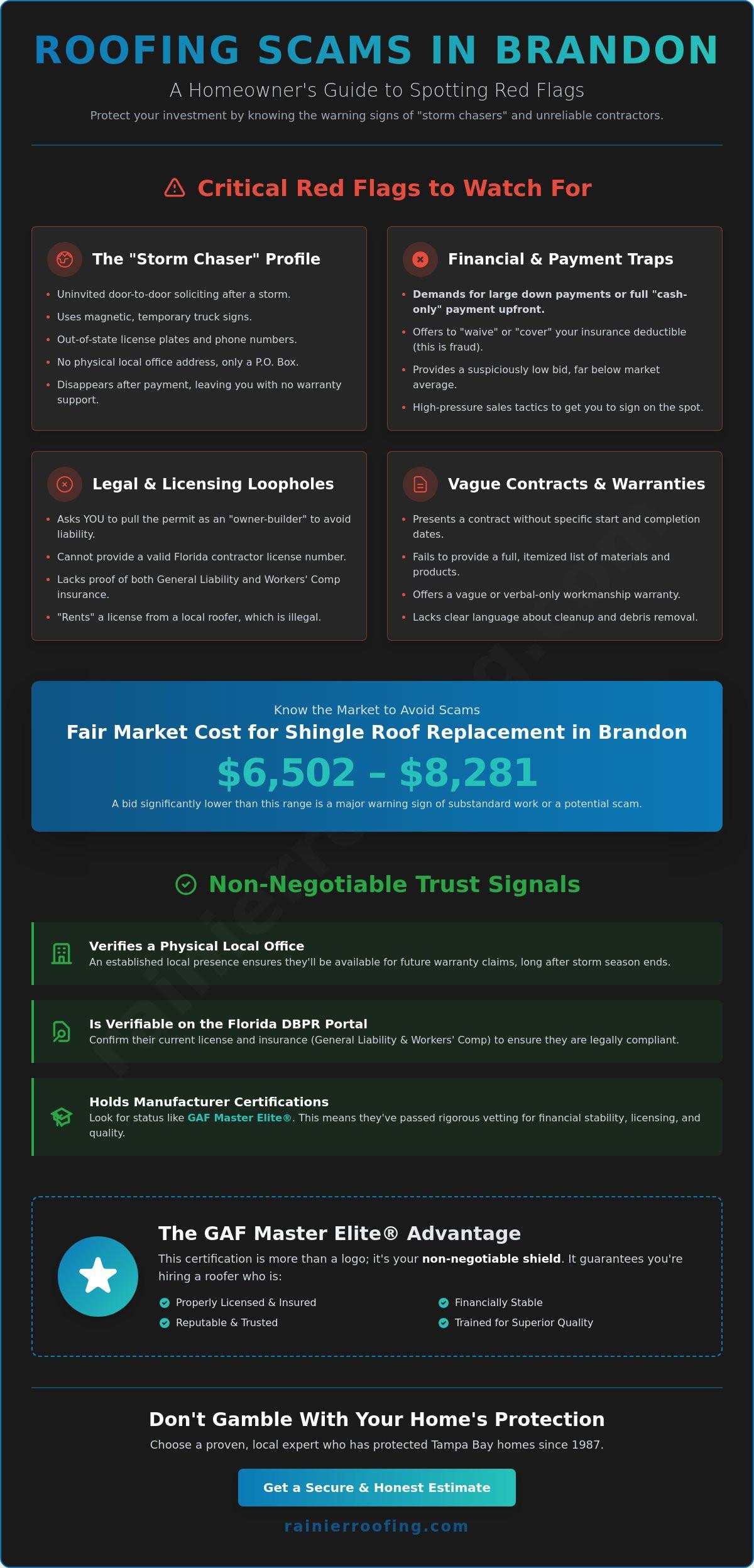
We’ll show you how to spot the warning signs of a scam before you sign a single document. You’ll learn what a legitimate Florida contractor license requires in 2026, why GAF Master Elite status is a non-negotiable shield for your home, and how to ensure your contract meets the latest disclosure requirements under HB 715. Our guide provides the clarity you need to find a local partner who understands that a fair shingle roof replacement in Brandon should reflect the current market average of $6,502 to $8,281. Since 1987, we’ve believed that local expertise is your best defense against seasonal scams.
Key Takeaways
- Verify a physical local office to ensure your contractor is available for future warranty claims rather than disappearing once the storm season ends.
- Avoid “cash-only” demands or full upfront payments, as these are major red flags when hiring a roofer Brandon homeowners should identify to prevent financial loss.
- Use the Florida DBPR portal to confirm your contractor holds current licenses and carries both general liability and workers’ compensation insurance.
- Protect your home by insisting on a written contract that includes specific start and end dates, a full material list, and clear workmanship warranties.
- Look for manufacturer certifications like GAF Master Elite status to find a professional who has already passed rigorous vetting for stability and quality.
Identifying Roofing Scams in Brandon: Why Local Knowledge Matters
Hiring a contractor is a major decision for any homeowner. In Brandon, that decision often happens under the stress of storm damage. One of the most common red flags when hiring a roofer Brandon residents experience is the uninvited knock on the door after a summer squall. Reputable local contractors rarely need to solicit door-to-door; their reputations and local history keep them busy. Many of these high-pressure solicitations operate similarly to what a confidence trick is, relying on your immediate anxiety to secure a signature. A legitimate roofer will provide a physical office address in the Brandon or Tampa area, not just a PO Box. If they can’t show you where they’ve been since 1987, they might not be around to honor your warranty in 2027.
Another critical warning sign involves the permitting process. If a contractor asks you to pull the permit with Hillsborough County as an “owner-builder,” they’re likely unlicensed or trying to avoid liability. A professional roofer handles every step of the legal paperwork. They ensure the installation meets current 2026 Florida building codes. Asking the homeowner to take on this legal responsibility is a massive liability shift that leaves you unprotected. Our team believes in full accountability, which starts with managing the technical and legal details of your roof replacement.
The “Storm Chaser” Phenomenon in Hillsborough County
Storm chasers are out-of-state contractors who follow major weather events across the country. They often flood the I-75 corridor with crews looking for quick insurance payouts. You can spot these operations by looking for magnetic truck signs that can be easily removed and out-of-state area codes on their business cards. An out-of-state license cannot pull legal permits for roofing work in the state of Florida. These crews arrive quickly, perform substandard work, and disappear before the first leak appears. Without a local presence, you have no recourse when the workmanship fails.
Why an Out-of-State License is a Major Warning Sign
Florida’s building codes are unique due to our intense heat and wind requirements. While High-Velocity Hurricane Zones (HVHZ) are primarily in South Florida, the entire state maintains rigorous standards for wind resistance and flashing. Out-of-state contractors often lack the specialized knowledge required to meet these codes. You should also watch for “license renting,” where an unlicensed outsider pays a local roofer to use their credentials. This practice is illegal and puts your investment at risk. Choosing a professional roofing company in Tampa ensures you’re working with experts who are personally accountable to the local community and have passed the required Florida Business and Finance exams.
Financial Red Flags: Money Upfront and “Too Good to Be True” Bids
Financial transparency is a cornerstone of professional roofing. When you receive an estimate, the payment structure should be clear, fair, and documented. One of the most dangerous red flags when hiring a roofer Brandon homeowners encounter is the demand for “cash only” payments or full payment before any work begins. This behavior often signals financial instability or an intent to vanish after the check clears. To protect your investment, you must recognize the signs of a home improvement scam before any money changes hands. A legitimate business has the financial health to manage its operations without using your deposit as its primary source of working capital.
In Florida, another serious red flag is a contractor offering to “waive” your insurance deductible. While it sounds like a helpful way to save money, this practice is actually considered insurance fraud under state law. Professional roofers will never ask you to participate in a scheme that involves misrepresenting costs to your insurance provider. Instead, we focus on providing accurate, honest assessments that align with your policy and the actual needs of your home. Integrity in billing is just as important as integrity in craftsmanship.
The Danger of Large Down Payments
Established companies maintain strong credit lines with local suppliers. They don’t need your cash to purchase shingles or underlayment for your Brandon home. The “material deposit” excuse is often used by contractors who lack the credit to secure supplies on their own. For a standard project, a safe deposit typically ranges from 10% to 25% of the total contract price. If a contractor insists on more than 50% before work begins, it’s time to find a more stable partner. You should never pay for materials before they arrive at your property and are verified by you.
Why the Lowest Bid Often Costs the Most in Brandon
Choosing the cheapest option can be tempting, but an unrealistically low bid is a major warning sign. These “low-ball” estimates often rely on cutting corners where you can’t see them, such as using inferior flashing or skipping high-quality underlayment. These contractors may also use “hidden change orders” once the old roof is removed, driving the final price far above the original quote. When you prioritize value and longevity over the bottom dollar, you ensure your home stays dry for decades. If you suspect your current roof needs professional attention, you can learn more about the Rainier Difference by reviewing our guide to roof repair in Tampa. If you’re ready for a transparent, honest assessment of your home, schedule a professional consultation with our family-owned team today.
Verifying Florida Credentials: Non-Negotiable Trust Signals
Trust isn’t just a feeling; it’s a verifiable fact. In Florida, the Department of Business and Professional Regulation (DBPR) is your first line of defense against substandard work. One of the major red flags when hiring a roofer Brandon residents should look for is a contractor who hesitates to provide their license number or offers a Business Tax Receipt as proof of expertise. A tax receipt is simply a local fee paid to the county to operate a business; it is not a roofing license and does not prove technical competency or state-mandated insurance compliance. Since 1987, we’ve maintained that transparency is the only way to build a lasting relationship with our neighbors.
Verifying a contractor takes less than five minutes but can save you thousands of dollars in legal fees. When you search for a professional, ensure they hold a certified license that allows them to pull permits in Hillsborough County. If a contractor cannot produce a valid license, they are likely operating illegally, which means your manufacturer warranty will be void from the moment the first shingle is nailed down. Professionalism starts with following the law.
Checking the DBPR for Active Florida Licenses
Visit the DBPR portal and search by the company name or license number. For roofing contractors, the license must begin with the “CCC” prefix. This stands for Certified Roofing Contractor and indicates the individual has passed both the Business and Finance exam and the Roofing Trade Knowledge exam. If the search results show a “Delinquent” or “Inactive” status, the contractor cannot legally perform work on your home. You should also review the “License Complaints” section for any history of disciplinary actions. A clean record is a sign of a company that values its community standing.
Workers’ Comp and General Liability: Don’t Risk Your Assets
Insurance is where many “tailgate” contractors cut corners to lower their bids. A common trick is providing “Proof of Insurance” that only covers General Liability. While this covers damage to your property, it does not cover injuries to the workers on your roof. If a worker falls and the contractor is “Exempt” from Workers’ Comp, the financial liability could fall directly on you as the homeowner. This is a legal nightmare that can put your home and life savings at risk. Always verify that you are working with licensed roofing contractors in Florida who carry active, non-exempt Workers’ Comp coverage. We recommend asking the contractor’s insurance agent to email the certificate of insurance directly to you. This ensures the policy is current and hasn’t been canceled for non-payment.
Finally, ask for proof of local experience. A reputable Brandon roofer should be able to provide a list of projects completed within your zip code in the last six months. Whether it’s a GAF Timberline HDZ shingle installation or a standing seam metal roof, seeing their craftsmanship in your own neighborhood is the ultimate trust signal. If they can’t show you a local project, they might be a storm chaser just passing through.
Red Flags in the Contract and Warranty Phase
A professional roofing contract serves as a roadmap for your project and a legal shield for your home. If a contractor presents a document that lacks a specific start date, completion date, or a detailed material list, you’re looking at one of the biggest red flags when hiring a roofer Brandon homeowners should avoid. Ambiguity in a contract often leads to “scope creep” where costs spiral out of control once the work begins. You should also be wary of high-pressure sales tactics like “today only” discounts. These are designed to rush your decision and prevent you from seeking a second opinion or verifying the company’s reputation. A reliable partner respects your need for clarity and time.
Watch out for vague language regarding rotten wood or decking replacement. While it’s true that a roofer can’t see the condition of the wood until the old shingles are removed, the contract must state a clear “per sheet” or “per linear foot” price for replacements. Without this, you might find yourself facing surprise charges on the final invoice. Protecting your investment means knowing exactly what you’ll pay before the first nail is driven. Since 1987, we’ve focused on transparency to keep our neighbors’ homes secure without the stress of hidden fees.
Verbal Promises vs. Written Scope of Work
If a roofer makes a promise during the estimate but refuses to put it in writing, that promise doesn’t exist. This “verbal warranty” trap is a common way for substandard contractors to avoid accountability. Your contract should specify the exact brand and line of shingles being used, such as GAF Timberline HDZ. It should also include a clause for a “lien waiver.” This document ensures that once you pay the contractor, their suppliers or subcontractors can’t place a lien on your Brandon property if the contractor fails to pay them. We believe in providing a comprehensive, written scope of work that leaves no room for doubt.
Understanding Manufacturer vs. Workmanship Warranties
Confusion between different types of warranties is a major source of anxiety for homeowners. A “Lifetime Warranty” claim is a red flag if the roofer can’t explain who provides it and what it covers. Generally, you have two layers of protection: a workmanship warranty from the contractor and a system warranty from the manufacturer. A workmanship warranty covers the installation itself, while the manufacturer warranty covers material defects. Many contractors only offer a 2-year labor warranty, which may not be enough to reveal long-term installation errors. By choosing GAF Master Elite roofers in Tampa, you gain access to enhanced warranties like the Golden Pledge, which covers both materials and workmanship for much longer periods. If you want a contract that prioritizes your peace of mind and long-term security, contact Rainier Roofing today for a detailed and transparent estimate.
Choosing a Reliable Brandon Roofer: The GAF Master Elite Advantage
Identifying red flags when hiring a roofer Brandon residents should avoid is much easier when you look for manufacturer-backed credentials. Manufacturer certifications act as a rigorous pre-vetting service that protects you from the risks we’ve discussed in previous sections. When a manufacturer like GAF certifies a contractor, they’re staking their own global reputation on that roofer’s financial stability and technical skill. This means the heavy lifting of checking licenses, insurance, and local standing has already been done by industry experts. Since 1987, our family-owned business has understood that these certifications are more than just badges; they are a promise of long-term security for your home.
Manufacturers won’t risk their brand on contractors who display financial instability or poor craftsmanship. Choosing a certified professional ensures that your installation follows the exact specifications required to trigger high-level warranties. Without these credentials, your “lifetime” warranty might be nothing more than a verbal promise that disappears as soon as the contractor leaves your driveway. We believe in providing our neighbors with the peace of mind that comes from verified excellence.
Why Manufacturer Certifications Filter Out Bad Contractors
GAF is North America’s largest roofing manufacturer and they only grant Master Elite status to the top 2% of roofing contractors nationwide. To qualify for this designation in 2026, a contractor must maintain a minimum of $1 million in general liability insurance plus full workers’ compensation coverage. They must also have been in business for at least seven years and maintain a Google rating of 4.0 stars or higher. These strict requirements effectively eliminate “storm chasers” and “tailgate contractors” who lack the longevity or financial health to meet such high standards. Master Elite status also grants you access to the Golden Pledge warranty, which covers both materials and workmanship for up to 50 years. This level of protection is only available through contractors who have proven their commitment to the highest industry standards.
The Rainier Difference: Protecting Brandon Homes Since 2008
Our commitment to the Brandon community is grounded in our identity as a Protective Professional. We’ve spent over 15 years mastering the unique challenges of the Tampa Bay climate, from intense UV exposure to high-velocity hurricane winds. We don’t use high-pressure sales tactics or “today only” pricing schemes; instead, we provide clear, expert guidance to help you make the best decision for your family. We treat every home as if it were our own, emphasizing craftsmanship and the “Rainier Difference” in every shingle we lay. If you’re ready for a roofing experience built on integrity and neighborly trust, we’re here to serve you. Contact Rainier Roofing for a transparent, red-flag-free estimate today. We’ll provide a methodical, steady process to ensure your investment is protected for decades to come.
Securing Your Home with a Trusted Brandon Partner
Your roof is the most critical line of defense against the Florida elements. Recognizing the common red flags when hiring a roofer Brandon homeowners face ensures your family stays safe and your budget stays intact. You now have the tools to verify Florida licenses, identify suspicious financial demands, and look for manufacturer certifications that guarantee quality. Choosing a contractor who values transparency over high-pressure sales is the most effective way to avoid the stress of a substandard installation.
Since 2008, we’ve served the Tampa Bay area as a family-owned and operated business. We take pride in our A+ rating and our status as a GAF Master Elite Certified contractor, a distinction held by only the top 2% of roofers nationwide. This legacy of stability means we’ll be here to stand behind our work for years to come. If you’re ready for a worry-free experience and maximum protection for your home, Get a Professional, No-Pressure Roofing Estimate from Rainier Roofing today. We’re ready to help you build a safer future for your property.
Frequently Asked Questions
How do I check if a Brandon roofer is actually licensed in Florida?
You can verify a license by visiting the Florida Department of Business and Professional Regulation (DBPR) website. Search for the company name or the license number provided by the contractor. A legitimate roofing license must carry the “CCC” prefix. This indicates the roofer has passed state exams and maintains the required insurance. If the license is “Delinquent” or not listed, do not allow them on your property.
Is it a red flag if a roofer asks me to pay for the materials directly?
Yes, asking a homeowner to pay a supplier directly is a major warning sign. Professional contractors have established credit lines with local suppliers and don’t need your cash to secure shingles or underlayment. When a roofer can’t buy their own materials, it suggests they lack financial stability or have poor credit. This leaves you at risk if the materials are delivered but the labor is never completed.
What should I do if a roofer knocks on my door after a storm in Brandon?
Politely decline their offer and ask for a business card to research their local office address later. Never sign any paperwork or “Assignment of Benefits” forms on your doorstep. Reputable Brandon contractors rely on their long-term community reputation rather than high-pressure door-to-door sales. Taking your time to investigate helps you avoid the common red flags when hiring a roofer Brandon homeowners often encounter during storm season.
Can a roofer in Florida legally waive my insurance deductible?
No, it is illegal for a contractor to waive, credit, or “absorb” an insurance deductible in the state of Florida. This practice is considered insurance fraud and can lead to serious legal consequences for both the contractor and the homeowner. A professional company will always provide an honest estimate that requires you to pay your deductible as dictated by your specific insurance policy and Florida law.
How many roofing estimates should I get before making a decision?
You should collect at least three written estimates from local, licensed contractors before choosing a partner. Comparing multiple bids allows you to spot outliers that are either suspiciously low or unfairly high. Ensure each estimate includes a detailed scope of work and the specific materials being used. This process gives you a clear picture of the current market rates for high-quality craftsmanship in the Tampa Bay area.
What is the difference between a roofing license and a business tax receipt?
A roofing license (CCC prefix) confirms a contractor has passed rigorous state exams and carries mandatory workers’ compensation and liability insurance. A business tax receipt is simply a local fee paid to Hillsborough County to operate a business. It does not verify any technical skills or safety knowledge. Hiring someone with only a tax receipt is one of the most dangerous red flags when hiring a roofer Brandon residents should avoid.
Why is a “low” bid sometimes considered a red flag for roofing?
An unrealistically low bid often means the contractor is cutting corners on essential components like flashing, ventilation, or high-quality underlayment. It can also indicate they are using uninsured labor to reduce overhead costs. While the initial price is tempting, these shortcuts typically lead to leaks and structural damage within just a few years. Investing in a fair, professional bid ensures your roof actually lasts its full intended lifespan.
What paperwork should I receive after my roof installation is complete?
You must receive a final invoice, a notarized lien waiver, and copies of your manufacturer and workmanship warranties. It is also important to keep the passed final inspection report from the Hillsborough County building department. These documents prove the work was completed to code and protect you from future legal or financial disputes. Having a complete paper trail is vital if you ever decide to sell your home or file an insurance claim.