

Your roof’s survival during a major storm doesn’t depend on how new it looks, but on the forensic integrity of its hidden connections. We understand the anxiety that comes with every June 1st start to the Atlantic hurricane season, especially when you’re facing rising insurance premiums and a sea of conflicting advice from door-knocking contractors. You want to know how to prepare your roof for a hurricane in Tampa without falling for high-pressure sales tactics. Since 1987, Rainier Roofing has stood as a guardian for local families; we’re here to provide clarity. This guide delivers a professional-grade plan to fortify your home against the 12 to 15 named storms predicted for 2026. You’ll discover how to leverage the $600 million proposed for the My Safe Florida Home program and why a $150 professional inspection is your best defense against water intrusion. We’ll walk you through the 8th Edition Florida Building Code requirements and the 25% rule so you can secure your family’s safety and lower your insurance risk profile with confidence.
Key Takeaways
- Understand why the June 1st deadline is critical for avoiding the “Tampa Bay Gap” of complacency before the 2026 storm season begins.
- Learn exactly how to prepare your roof for a hurricane in Tampa by focusing on envelope protection and the physics of the “Edge Effect” to prevent shingle failure.
- Identify the limitations of ground-level visual checks and discover why a professional forensic inspection is necessary to reveal hidden structural vulnerabilities.
- Navigate the latest state grant programs and insurance requirements to lower your risk profile while ensuring compliance with the 8th Edition Florida Building Code.
- Discover the peace of mind that comes from a 7-step action plan designed to secure your home’s perimeter against high-wind events and water intrusion.
Why Tampa Bay Roof Preparation is Unique in 2026
Hurricane roof preparation is the professional process of ensuring your home’s structural integrity is verified before the June 1st start of the Atlantic season. In our region, this preparation is complicated by the “Tampa Bay Gap.” Because we haven’t seen a direct hit from a major hurricane in over a century, a sense of dangerous complacency has settled over many neighborhoods. This is a mistake. The 2026 climate outlook indicates warmer Gulf temperatures that can lead to rapid storm intensification, with current forecasts predicting 12 to 15 named storms. Understanding how to prepare your roof for a hurricane in Tampa starts with acknowledging that your roof is the first line of defense against these strengthening systems.
While coastal residents in Pinellas deal with immediate surge threats, neighbors in Brandon, Odessa, and Lutz face the “Salt Air Factor.” Salt-laden air travels miles inland, silently corroding metal fasteners and weakening the bond of shingle adhesives over years of exposure. This proactive approach to maintenance aligns with global standards for Tropical cyclone preparedness, focusing on retrofitting and forensic inspection before the clouds gather. Since 1987, we’ve helped families bridge the gap between simple maintenance and true storm readiness.
The Geography of Risk: From Hillsborough to Pinellas
The shallow shelf of the Tampa Bay coast is a double-edged sword. It increases the potential for significant storm surge while also creating wind turbulence as air moves from the flat Gulf onto the varied terrain of the city. Inland areas like Wesley Chapel aren’t immune; they frequently face intense microbursts that can mimic hurricane-force winds. The fetch of wind across the ten-mile span of open water in the Bay allows air to gather unchecked speed, resulting in extreme upward pressure on your roof’s perimeter. These localized wind patterns mean that even homes miles from the beach require professional-grade fortification.
The 2026 Florida Building Code: What Homeowners Must Know
As of May 2026, all roofing work must comply with the 8th Edition of the Florida Building Code, which became effective on December 31, 2023. This code prioritizes secondary water barriers for all new installations to prevent interior damage if shingles are lost during a high-wind event. If your roof is more than 15 years old, it likely lacks the wind-speed ratings that modern insurance carriers now demand for policy renewals. Knowing how to prepare your roof for a hurricane in Tampa means ensuring your system meets these 2026 standards to lower your insurance risk profile. We believe in craftsmanship that lasts, and meeting these updated codes is essential for your family’s long-term security.
The Science of Wind Uplift and Shingle Adhesion
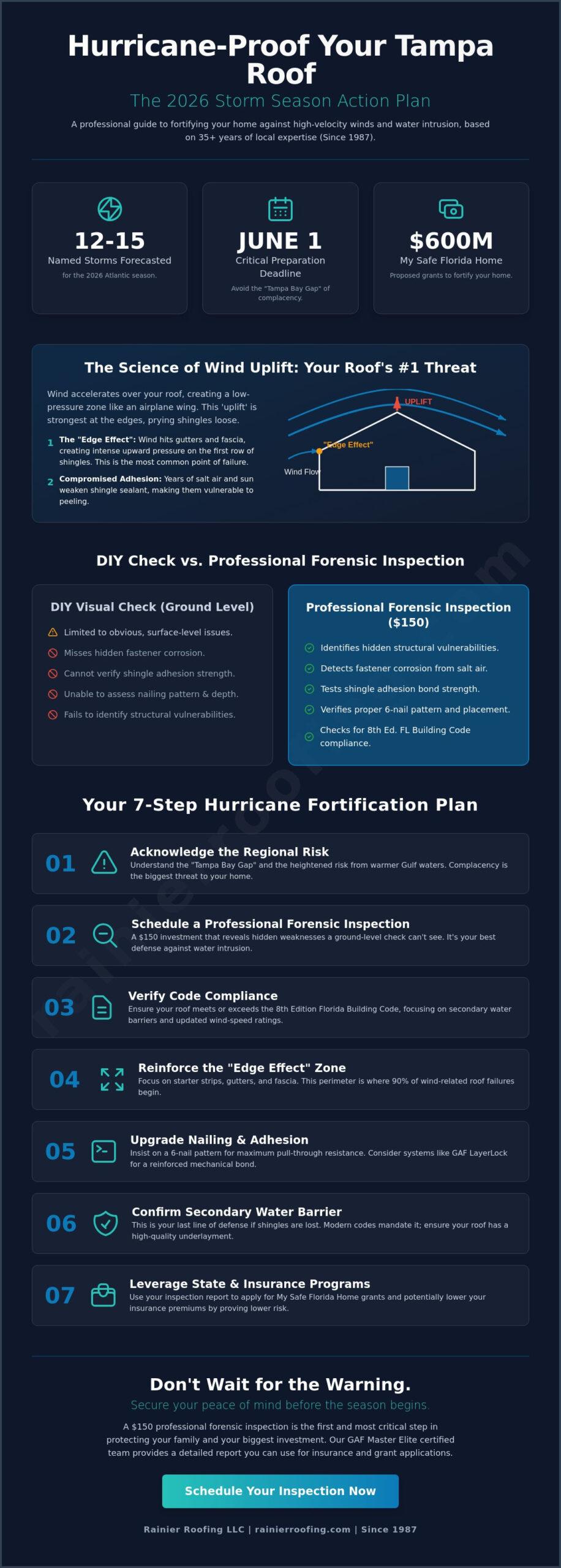
Wind doesn’t just blow against your house; it tries to lift your roof off. As air accelerates over the peak of your home, it creates a zone of low pressure that acts exactly like an airplane wing. This phenomenon, known as wind uplift, is the primary reason shingles peel back during a storm. Most failures originate at the “Edge Effect” zone, where the wind first hits your gutters, soffits, and fascia. If you’re researching how to prepare your roof for a hurricane in Tampa, you must focus on these critical perimeter points. According to the Asphalt Roofing Manufacturers Association, proper adhesion is your strongest defense against high-velocity wind events. We utilize GAF LayerLock technology to create a reinforced mechanical bond between shingle layers. This system qualifies for the WindProven Limited Wind Warranty, which in 2026 provides coverage for infinite wind speeds when installed with the required GAF components.
The Role of Starter Shingles and Nailing Patterns
The first row of shingles, known as the starter strip, is your roof’s anchor. If this row lifts, the wind gets underneath the entire system. Standard contractors often use only four nails per shingle, but the Rainier Difference involves a specific Master Elite six-nail pattern. This placement is strategically designed to maximize pull-through resistance. Poor nail placement, such as high-nailing above the seal line, is a leading cause of roof failure in Florida. We ensure every nail is driven at the correct depth and angle to provide maximum protection.
Secondary Water Barriers: Your Last Line of Defense
Even the best shingles can be stripped by a major hurricane. Your secondary water barrier is what stands between the storm and your living room. The 8th Edition Florida Building Code now mandates enhanced water barriers for all new installations. We favor self-adhered, “peel and stick” membranes over traditional felt paper because these membranes seal directly to the roof deck. If your shingles blow off, this barrier keeps the water out. This level of protection can prevent a total interior loss. If you’re unsure about your current underlayment, a professional wind mitigation assessment can clarify your home’s readiness. Knowing how to prepare your roof for a hurricane in Tampa means having a backup plan that keeps your family dry even when the shingles are gone.
DIY Visual Inspection vs. Professional Forensic Inspection
Every homeowner wants to feel secure as June 1st approaches. You might walk your property line and think everything looks fine, but a ground-level view is only the beginning of true storm readiness. Learning how to prepare your roof for a hurricane in Tampa requires more than a casual glance from the curb. While the “Binocular Test” can reveal missing shingles, it fails to detect the microscopic failures in seal strips or the hidden corrosion of fasteners that lead to catastrophic uplift during a major wind event.
Many neighbors ask why they should invest $150 to $500 in a professional inspection when they don’t see any active leaks. The reality is that the 2026 insurance market rewards proactive documentation. A professional audit provides a “roof certification” that can lower your insurance risk profile and prove your home meets the current 8th Edition Florida Building Code. We don’t just look at the shingles; we conduct a forensic review of the entire roofing system to ensure your family’s safety remains uncompromised.
The Ground-Level Checklist for Tampa Homeowners
You can identify early warning signs without ever climbing a ladder. Start by checking your downspouts for “granule snow,” which looks like coarse, dark sand. Excessive shedding indicates your shingles are losing their protective layer, a common issue we see during a gutter installation Tampa residents trust for drainage. Look for shingles that are curling or “fish-mouthing” at the edges. This is often a sign of thermal shock from the intense Florida sun, which makes shingles brittle and prone to snapping when hit by 100 mph gusts. Finally, check for any visible gaps in the flashing around your chimney or skylights, as these are the most common entry points for water intrusion.
What a GAF Master Elite Roofer Looks For
Our team goes where the binoculars cannot reach. As a GAF Master Elite contractor, a status held by only 2% of roofers, we perform a manual lift test to verify seal-strip integrity. If the shingle doesn’t firmly resist being lifted by hand, it will not survive a hurricane. We also perform attic moisture mapping to find rusted nails or mold. These are indicators of slow, hidden leaks that can lead to deck rot. Most importantly, we verify the structural connection of your roof deck to the trusses. If your home lacks modern hurricane straps, retrofitting them can cost between $1,000 and $5,000, but the investment often pays for itself through insurance premium credits within three to five years. This is the ultimate step in how to prepare your roof for a hurricane in Tampa with total confidence.
A 7-Step Action Plan to Fortify Your Tampa Roof Before June 1st
Preparation is a methodical process that begins long before the first tropical wave appears on the radar. Ideally, your timeline should start in March or April. This window allows you to secure materials and schedule professionals before the rush of the season begins on June 1, 2026. If you’re wondering how to prepare your roof for a hurricane in Tampa, the answer lies in “Envelope Protection.” This means sealing every possible entry point for wind and water to ensure your home’s interior remains dry and secure. For minor issues identified during this phase, a targeted roof repair Tampa FL can prevent a small leak from turning into a structural failure under storm pressure.
Steps 1-4: Immediate Maintenance and Debris Management
- Step 1: Clear your gutters. Clogged gutters cause water to back-surge under the eave during the heavy downpours common in the Florida rainy season. This leads to rotted fascia and water intrusion behind your siding.
- Step 2: Trim overhanging branches. Ensure all trees are at least 10 feet away from your roofline. During high-wind events, branches can “whip” against shingles, scraping off the protective granules or puncturing the roof deck.
- Step 3: Secure loose flashing. Check the metal transitions around chimneys and vents. Use high-grade solar-resistant sealant to close any gaps that could be exploited by wind-driven rain.
- Step 4: Inspect soffits and fascia. These are the most vulnerable parts of your roof’s perimeter. If wind enters through a damaged soffit, it can create internal pressure in your attic that helps lift the roof off the walls.
Steps 5-7: Structural Reinforcement and Documentation
Once the exterior is clear, move to the structural integrity of the system. Step 5 involves verifying your hurricane straps or clips. As of May 2026, retrofitting these connectors generally ranges from $1,000 to $5,000, but they’re essential for keeping your roof attached to your home’s frame during 100+ mph gusts. Step 6 is documentation. Take high-resolution photos of your entire roof from the ground to establish an insurance baseline. This evidence is vital if you need to file a claim later in the year. Finally, Step 7 is scheduling a professional tune-up. A seasoned expert can identify the “Edge Effect” vulnerabilities that a simple visual check might miss. If you’re ready to secure your home’s future, schedule your pre-season inspection today. Learning how to prepare your roof for a hurricane in Tampa is the first step toward a worry-free summer and a protected family home.
Beyond Prep: Partnering with a Protective Professional
Taking the right steps on your own is a fantastic start, but the final layer of security comes from a partnership with a seasoned expert. We’ve served as guardians of local homes since 1987, providing the technical expertise that only a legacy business can offer. When you’re deciding how to prepare your roof for a hurricane in Tampa, the credentials of your contractor matter just as much as the materials they use. Rainier Roofing is proud to be a GAF Master Elite roofer, a distinction held by only 2% of roofing contractors nationwide. This status allows us to provide the highest level of warranty protection and ensures that your roof meets the rigorous 8th Edition Florida Building Code standards required in 2026.
For homeowners seeking the absolute maximum in storm resistance, we often recommend exploring metal roofing Tampa residents rely on for its 140+ mph wind ratings. While asphalt shingles are excellent, a properly installed metal system offers a level of longevity and “worry-free” security that is unmatched in the Florida climate. Whether you choose shingles or metal, our goal is to provide a protective shield that stands firm against the 12 to 15 named storms predicted for this year.
The Rainier Difference: More Than Just a Roof
We operate under a “Guardian” philosophy. This means we don’t just see a project; we see a family that needs protection. Our commitment to the community doesn’t end when the sun is shining. If the 2026 season brings unexpected damage, our team is ready to provide emergency roof tarping to prevent further water intrusion until permanent repairs can be made. Our deep roots in Bradenton and Tampa mean we’ll be standing by our work long after the storm clouds have cleared. We value the neighborly trust we’ve built over nearly four decades, and we treat every home with the same integrity we’d give our own.
Next Steps: Your No-Obligation Storm Readiness Audit
You shouldn’t have to navigate hurricane season with a sense of dread. We offer a clear, logical path forward through our professional readiness audit. During this inspection, we’ll verify your roof-to-wall connections, check for shingle adhesion failures, and provide a detailed report for your insurance carrier. We don’t believe in the aggressive “hard sell” tactics used by door-knocking contractors. Instead, we provide a steady, confidence-inspiring assessment of what your home actually needs to stay safe. Knowing how to prepare your roof for a hurricane in Tampa starts with a simple conversation. Protect your family home; schedule your hurricane prep inspection with Rainier Roofing today!
Secure Your Family Home Before the 2026 Hurricane Season Begins
Your roof doesn’t have to be a source of anxiety as the June 1st deadline approaches. You’ve learned that true storm readiness isn’t just about a visual check; it’s about the forensic bond of your shingles and the structural integrity of your hurricane straps. By following our 7-step action plan and ensuring your home meets the 8th Edition Florida Building Code, you’re taking proactive steps to lower your insurance risk profile. Knowing how to prepare your roof for a hurricane in Tampa means replacing dangerous complacency with professional-grade fortification.
As an A+ rated, family-owned business with local roots since 1987, we’re here to act as your home’s guardian. Our GAF Master Elite status puts us in the top 2% of roofers, giving you access to superior warranties and craftsmanship that stands the test of time. Don’t wait for the first tropical warning to assess your vulnerabilities. Secure your home before the storm; request your free 2026 Hurricane Readiness Audit now! We’ve stood with Tampa Bay families through decades of weather; let us provide the steady, rhythmic assurance you need for a safe and worry-free year.
Frequently Asked Questions
How much wind can a standard shingle roof in Tampa handle?
Standard architectural shingles installed according to the 8th Edition Florida Building Code are rated for wind speeds between 110 and 130 mph. If you utilize GAF LayerLock technology with a WindProven warranty, those shingles are technically rated for infinite wind speeds when installed with four required GAF accessories. This is a critical component of how to prepare your roof for a hurricane in Tampa to ensure your home survives a major 2026 storm event.
Does my homeowners insurance cover a roof replacement before a hurricane hits?
Homeowners insurance typically does not cover proactive roof replacement before a storm occurs. Policies are designed to cover sudden and accidental losses rather than general wear or preventative maintenance. If your roof has existing damage, you should address it immediately to avoid a claim denial later. We recommend reviewing your policy’s hurricane deductible before June 1st so you understand your out of pocket costs if a claim is filed.
What is the best roofing material for hurricane resistance in Florida?
Standing seam metal roofing is widely considered the most hurricane resistant material available for Florida homes. These systems are often rated for winds exceeding 140 mph because the panels are interlocked and fastened directly to the deck without exposed nails. While asphalt shingles are highly effective when properly installed, metal provides a higher level of worry-free security against the rapid intensification of Gulf storms.
How do I know if my roof has hurricane clips or straps?
You can verify the presence of hurricane straps by looking in your attic where the roof trusses connect to the top of the exterior walls. You should see metal plates or wraps securing the wood together. If you’re unsure, a professional wind mitigation inspection is the most reliable method. This documentation is required by most Florida carriers to qualify for the premium discounts associated with the My Safe Florida Home program.
What should I do if I find a leak during a tropical storm?
Your safety is the priority; never attempt to climb on your roof during a tropical storm or high wind event. If you notice a leak, place buckets to catch water and move furniture to prevent interior damage. Once winds drop below 40 mph, contact us for emergency tarping services. We provide these rapid response solutions to bridge the gap between the initial leak and a permanent repair.
Can I install hurricane shutters on my own, or does it affect the roof?
Hurricane shutters are typically installed on window frames or exterior walls and do not directly affect your roofing system. However, you must ensure that mounting brackets are not drilled into the fascia or soffits. Damaging these perimeter components can allow wind to enter your attic. This creates the internal pressure that leads to roof uplift, so always follow manufacturer guidelines to maintain your home’s envelope protection.
How long does a professional hurricane roof inspection take?
A professional forensic roof audit generally takes between 45 and 90 minutes to complete. During this time, our technicians inspect the shingle adhesion, flashing integrity, and attic ventilation systems. This thorough process is a cornerstone of how to prepare your roof for a hurricane in Tampa because it reveals the hidden vulnerabilities that a casual visual check from the driveway will always miss.
Is it worth upgrading to a metal roof in Tampa for hurricane protection?
Upgrading to a metal roof is a significant investment that often pays for itself through increased home value and insurance premium reductions. Metal systems frequently last 40 to 50 years, nearly double the lifespan of traditional asphalt. For Tampa homeowners concerned about the 2026 climate outlook and storm surge risks, the added structural integrity and wind resistance provide an invaluable sense of long term security.