

What if the decision to delay your home upgrades by just one season could lead to a 15% increase in total project costs and a voided structural warranty? For many Tampa families, the dream of energy independence often feels overshadowed by the fear of contractors pointing fingers at one another when a leak appears. Choosing to install a new roof and solar panels at the same time isn’t just a matter of convenience; it’s a strategic move to protect your largest investment against Florida’s unpredictable elements.
We know you’re likely feeling the pressure of recent utility rate increases and the stress of managing complex home repairs. It’s frustrating to worry about whether a solar installer will compromise the integrity of your shingles. This guide shows you why coordinating these projects is the most critical financial and structural decision you’ll make for your home in 2026. You’ll learn how to secure a leak-free home and lower utility bills under the Rainier Difference of a single, cohesive 25-year protection plan. We’ll outline the exact steps to ensure your roof remains a fortress while your home generates its own clean power.
Key Takeaways
- Align your roof’s lifespan with your energy system to avoid the “Lifecycle Lock” and prevent the high cost of removing panels for future repairs.
- Compare traditional bolt-on systems with integrated solar shingles to find the most storm-resistant and energy-efficient path for your specific home.
- Learn why coordinating a new roof and solar panels through a GAF Master Elite contractor is the only way to guarantee your long-term warranty remains intact.
- Identify the critical difference between flashing and sealant to ensure your solar installation withstands Tampa’s heaviest tropical downpours without leaking.
- Use our professional checklist to verify your home’s structural health and baseline readiness before committing to any solar investment.
Why a New Roof and Solar Panels Must Be Planned Together in Tampa
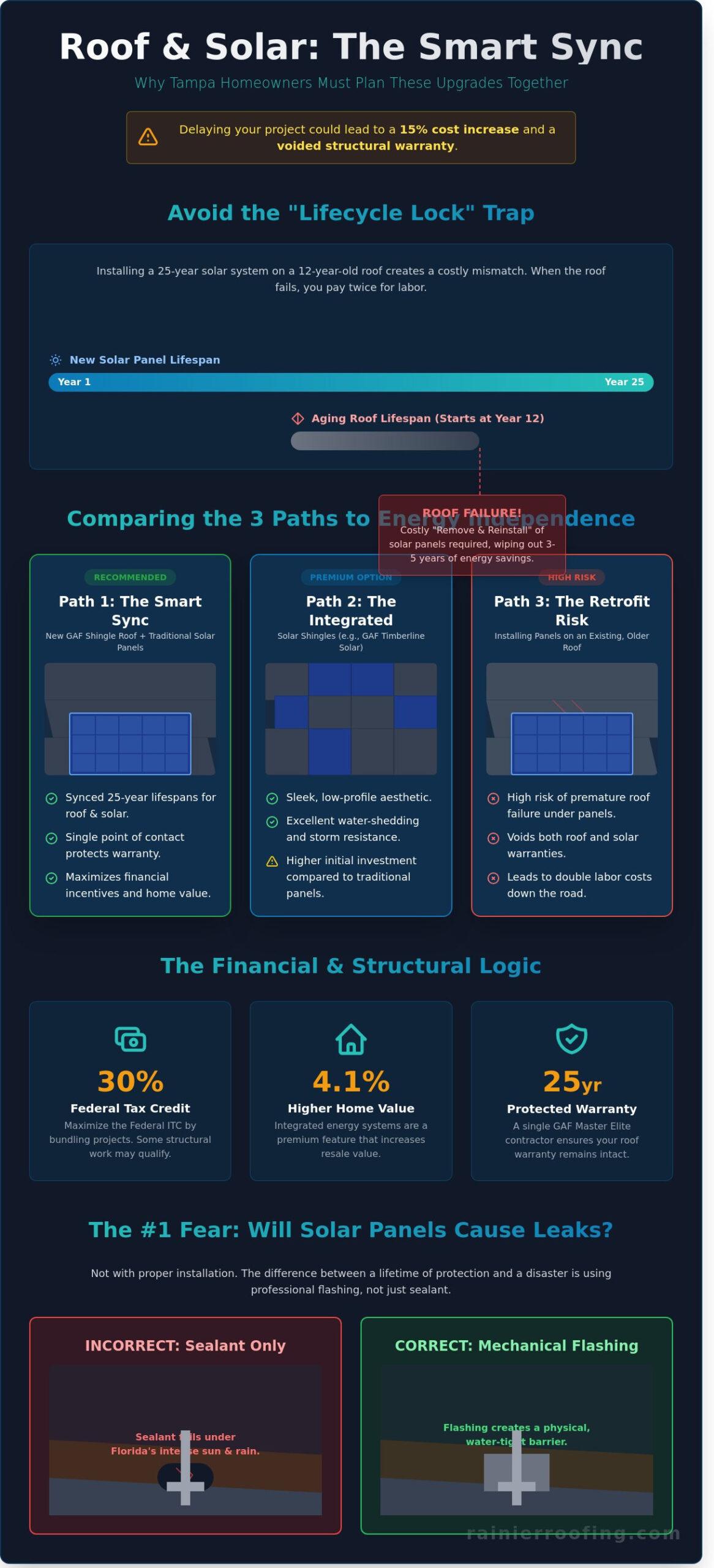
Thinking about a new roof and solar panels as separate home improvements is a mistake that often costs Tampa homeowners thousands of dollars in avoidable labor. At Rainier Roofing, we call this the Lifecycle Lock. Most Tier 1 solar panels carry a 25 year performance warranty. To protect your home properly, your roofing material must match that lifespan. Installing a high-tech energy system on a roof that is already 12 years old creates a financial ticking clock. When those shingles eventually fail, you will have to pay a solar crew to remove the panels and a roofing crew to replace the deck, then pay the solar team a second time for reinstallation. This Remove and Reinstall process frequently costs thousands of dollars, which can effectively wipe out three to five years of your energy savings.
The Florida Building Code 8th Edition, which took effect December 31, 2023, mandates strict wind-load requirements for any rooftop attachment in High Velocity Hurricane Zones. In the Tampa Bay area, where design wind speeds can reach 150 mph, the structural connection between your solar mounts and your roof rafters must be flawless. The intense Florida sun also creates a unique micro-climate between the panels and the shingles. Without professional coordination, trapped heat can bake your shingles from the top down. This leads to premature granule loss and brittle asphalt, especially in the areas directly surrounding the mounting brackets where thermal expansion is most volatile.
The Financial Logic of Simultaneous Installation
Bundling these projects allows you to streamline labor and maximize the 30% Federal Investment Tax Credit for the solar portion of the project through 2032. While the IRS typically excludes the roof itself from this credit, structural reinforcements or specialized flashing required specifically for the panels may qualify under certain conditions. In high-growth markets like Lutz and Odessa, homes with integrated energy systems sold for 4.1% more than non-solar homes according to 2019 Zillow research. Coordinating the install ensures your roof warranty stays intact, as a single professional team manages the penetrations and flashing integrity.
Protecting the Structural Integrity of Your Home
Before signing a solar contract, a professional roof inspection is mandatory, especially in Pinellas County where salt air and humidity accelerate wood rot in the fascia and soffits. Our team evaluates the roof deck to ensure it can support the additional 2.5 to 4 pounds per square foot that a racking system adds. We also verify that the solar layout does not obstruct your attic ventilation. If panels block your ridge vents, your attic temperature can spike by 20 degrees, forcing your AC to work harder and negating the very savings you expected from your new roof and solar panels.
Comparing the 3 Paths to Energy Independence in Florida
Choosing a new roof and solar panels requires a clear strategy to handle Florida’s unique environmental stressors. Since 1987, we have watched Tampa homeowners navigate the transition from standard shingles to high-tech energy producers. You generally have three distinct paths to consider when upgrading your home’s exterior and energy efficiency.
- Path 1: Traditional Solar Panels on a New GAF Shingle Roof. This remains the most popular choice. We install a high-performance base, such as GAF Timberline HDZ shingles, and a solar partner installs the racking system on top.
- Path 2: Solar Shingles (Integrated Roofing). This path uses products like GAF Energy’s Timberline Solar, where the solar technology is built directly into the shingle. It replaces the “bolt-on” look with a sleek, water-shedding surface.
- Path 3: The Retrofit Risk. This involves installing panels on an existing roof. If your roof is older than 10 years, this path often leads to premature failure and double the labor costs when the roof eventually needs replacement.
For homeowners concerned about the 150mph hurricane wind requirements in the Tampa Bay area, the combination of GAF Timberline HDZ shingles and integrated solar often provides the most security. The GAF WindProven limited wind warranty has no maximum speed limitation when installed with the required combination of GAF accessories, making it a formidable defense against tropical systems.
Traditional Panels vs. Integrated Solar Shingles
Aesthetics often drive the choice between these two systems. Traditional racking systems sit several inches above the roofline, which some homeowners find bulky. Integrated solar shingles offer a low-profile look that blends into the roofline. However, durability is the real metric that matters in Florida. GAF Timberline HDZ shingles feature LayerLock technology, creating a mechanically fused bond that serves as a rock-solid foundation for any solar attachment. If a major storm damages a single panel, traditional bolt-on systems are often easier to repair because the components are modular and easily accessible. Integrated systems require specialized roofing knowledge to ensure the water-tight seal remains intact during a repair.
The “Old Roof” Warning for Tampa Homeowners
Most reputable solar companies refuse to install panels on a roof with less than 5 years of remaining life. In the intense Wesley Chapel heat, shingles become brittle as the asphalt oils evaporate over time. Installing heavy racking systems on 12-year-old shingles is a recipe for disaster. The thermal expansion of metal solar mounts can cause aging shingles to crack, leading to leaks that are difficult to locate under a sea of panels. This is why coordinating a new roof and solar panels at the same time is the only way to ensure your warranties remain valid and your home stays dry. Since 1987, we have seen that a proactive replacement prevents the $200 per panel “remove and reinstall” fee that homeowners face when they realize their old roof cannot support a 25-year solar commitment.
The Tampa Homeowner’s Checklist for Roof-Solar Coordination
Coordinating a new roof and solar panels requires a methodical approach to protect your home from Florida’s 150 mph hurricane-force winds. Since 1987, we’ve seen that the best results come from a unified timeline that prioritizes structural integrity. Follow these five steps to ensure your investment remains secure for the next 25 years.
- Step 1: Get a GAF Master Elite roof inspection. We verify if your current roof deck meets the 2023 Florida Building Code standards. As a Master Elite contractor, we belong to the top 2% of roofers nationwide, ensuring your baseline health is documented for insurance purposes.
- Step 2: Verify your warranty coverage. You must confirm that solar penetrations won’t void your leak protection. We review your specific GAF warranty to ensure every rack attachment is compliant.
- Step 3: Coordinate permits. This involves filing paperwork with Hillsborough County and your utility provider simultaneously. A mismatch in permit data can delay your “Permission to Operate” by several weeks.
- Step 4: Install solar-ready flashing. We install specialized mounts during the reroofing process. This allows the solar team to bolt directly to pre-sealed points, which prevents the need to pry up new shingles later.
- Step 5: Conduct a final joint inspection. Once the panels are set, we perform a walk-through to ensure no shingles were cracked or seals broken during the heavy equipment phase.
A new roof and solar panels installation is a significant upgrade that demands professional oversight. By following this sequence, you eliminate the risk of two different crews blaming each other for a future leak.
Navigating Local Permitting and Utility Rules
Tampa homeowners must coordinate with TECO or Duke Energy for net metering approval. This process typically requires 30 to 45 days for technical review. We review your solar layout before it goes to the county because Hillsborough County enforces strict ASCE 7-22 wind-load standards. If your solar racks are placed too close to the roof edges (the “perimeter zones”), they may fail inspection due to high uplift pressures during storms.
Ensuring Your GAF Warranty Stays Intact
Your protection depends on using certified flashing kits for every roof penetration. When we install a GAF WindProven warranty, there’s no maximum wind speed limitation, but this coverage stays valid only if the solar mounts don’t compromise the shingle seal. Our Master Elite status acts as your safeguard. We document the installation of GAF Solar Deck-Mounts to prove that the roof’s structural integrity remains uncompromised, keeping your long-term leak protection fully active.
Addressing the #1 Fear: Will Solar Panels Cause My New Roof to Leak?
Many Tampa homeowners hesitate to invest because they worry that a new roof and solar panels are a recipe for water damage. This is a common myth. When installed with precision, solar mounts are as watertight as your plumbing vents or chimney flashing. The danger isn’t the technology itself; it’s the “solar cowboy” who treats your roof like a simple equipment rack rather than a complex weather barrier. Since 1987, we’ve seen how amateur shortcuts lead to expensive repairs.
The secret to a dry home lies in mechanical flashing rather than topical sealants. In the 95 degree Florida heat, standard caulking can dry out and crack within 24 months. Professional installers use metal flashing that slides directly under the shingles, creating a physical shield that directs water downward. This is the core of the Rainier Difference. Our team provides expert oversight to ensure every mounting point respects the natural flow of water across your roof deck.
Common Installation Mistakes That Lead to Leaks
Amateur crews often rush the attachment process, leading to “missed rafters.” When a lag bolt misses the wood, it leaves a “pilot hole” that acts as a direct conduit for water into your attic. Industry data suggests that roughly 12 percent of DIY or low-bid solar installs suffer from at least one structural attachment error. On metal roofs, using incompatible fasteners can trigger galvanic corrosion. This chemical reaction between different metals can eat through a panel in less than 6 years, compromising the entire system’s integrity.
Post-Solar Roof Maintenance in the Tampa Bay Area
Your responsibility doesn’t end once the new roof and solar panels are in place. Florida’s heavy oak canopy means debris like leaves and Spanish moss often trap moisture behind solar racks. This trapped organic matter leads to premature shingle rot if not cleared annually. Managing the increased water velocity is also vital. Because solar panels are non-porous, they create heavy runoff during Brandon or Lutz thunderstorms. Upgrading to seamless gutter systems is a proven way to handle this surge and protect your foundation from erosion. Tampa receives over 51 inches of rain annually, which means pairing your solar investment with professional gutter installation Tampa homeowners rely on is essential to prevent fascia rot and foundation erosion from the concentrated runoff solar panels produce. Keeping those gutters free of debris is equally critical; scheduling routine gutter cleaning Tampa professionals recommend ensures the increased runoff from your panels flows freely through the system instead of overflowing onto your fascia and foundation. If you notice a damp spot after a tropical depression, don’t wait. A quick inspection of the mounting feet can prevent a minor drip from becoming a major structural issue.
Protect your home with a system designed to last. Contact Rainier Roofing today for a professional solar-ready roof consultation.
Conclusion: Building a Storm-Resistant, Energy-Efficient Future
Choosing a “Roof-First” strategy isn’t just about logic; it’s about financial protection. By ensuring your home has a solid foundation before installing a new roof and solar panels, you avoid the high costs of removing and resetting equipment for mid-lifecycle repairs. This coordination ensures your roof’s 25-year warranty aligns perfectly with your solar system’s 25-year production guarantee. In Tampa’s climate, where 130-mph winds are a seasonal reality, this unified approach creates a fortress that lowers your utility bills while standing firm against the elements. You’re not just buying a product; you’re investing in a long-term shield for your family.
The Rainier Difference in Tampa Bay
Rainier Roofing has protected local families since 1987. We understand that your home is your most significant investment. Our GAF Master Elite Certification places us in the top 2% of contractors nationwide, which is a distinction that directly benefits your wallet. This certification allows us to provide the Golden Pledge Warranty, offering 50 years of non-prorated coverage on materials. We don’t just nail shingles; we engineer solar-ready platforms. You can request a free, professional roof-and-solar consultation today to see how we bridge the gap between traditional craftsmanship and modern energy technology.
Your Next Steps Toward a Cooler, Safer Home
Taking the first step is simple and data-driven. We utilize drone-assisted roof inspections that provide high-resolution imagery of your current deck’s condition. This precision technology allows us to identify micro-fractures or structural weaknesses that traditional walk-throughs often miss. Once we have a clear picture, we’ll review our metal and tile roofing options. These materials offer the highest solar compatibility and can reflect up to 70% of solar heat, keeping your attic significantly cooler. If you’re also considering ways to bring more natural light into your home while maintaining energy efficiency, professional skylight installation and replacement can complement your solar strategy by reducing daytime lighting costs while providing proper impact-rated protection against Florida storms.
Contact our Tampa office to receive a specialized “Solar-Ready” roofing estimate. Our team will coordinate with your solar provider to ensure every flashing and mounting point meets Florida’s strict building codes. Don’t leave your home’s safety to chance. A new roof and solar panels represent a commitment to your family’s future and your property’s value. Let us provide the peace of mind you deserve. Reach out to Rainier Roofing today and let our family protect yours for the next 40 years.
Secure Your Tampa Home for a Sustainable 2026
Investing in a new roof and solar panels isn’t just about lower utility bills; it’s about structural integrity and long-term protection for your family. By coordinating these projects, you ensure your home meets the strict requirements of Florida’s High-Wind Zones while maximizing the lifespan of both systems. This proactive approach prevents the logistical headache and added expense of retrofitting solar mounts on an aging surface later.
Rainier Roofing has served the Tampa Bay area since 2008. We are GAF Master Elite Certified, a distinction held by the top 2% of roofing contractors nationwide. This means your installation is backed by the highest level of craftsmanship and rigorous standards required for Florida’s unique climate. We specialize in high-wind zone installations, ensuring your home remains a safe haven through every storm season. You deserve the peace of mind that comes from working with a local partner who treats your home like their own.
Get Your Free Solar-Ready Roof Estimate in Tampa
Take the first step toward a more resilient and energy-efficient future today.
Frequently Asked Questions
Do solar panels void my roof warranty in Florida?
Solar panels don’t void your entire roof warranty as long as the installation follows the Florida Building Code and manufacturer guidelines. Under the Magnuson-Moss Warranty Act, a manufacturer can’t legally cancel your coverage just because you added panels. However, the roofer won’t cover leaks caused specifically by the solar mounts. Rainier Roofing coordinates with installers to protect your warranty and maintain the high standards we’ve held since 1987.
How much extra does it cost to coordinate a roof replacement with solar?
Coordination typically saves homeowners between $1,000 and $3,000 compared to doing the projects separately. These savings come from combined permitting fees and reduced labor for staging equipment. According to data from the Solar Energy Industries Association, integrated scheduling prevents the need to remove and reinstall panels later. We streamline this process to ensure your new roof and solar panels are installed with professional precision and neighborly care.
Should I get a metal roof if I plan on going solar in Tampa?
Yes, a standing seam metal roof is the best choice for solar because it uses non-penetrating clamps to secure the panels. This setup preserves the integrity of your roof deck and eliminates the risk of leaks from drill holes. Since a metal roof lasts 50 years, it perfectly matches the 25 year lifespan of your solar system. This combination offers the long term security and craftsmanship that Tampa families expect from a legacy contractor.
What happens if my solar panels are damaged in a hurricane?
Your homeowner’s insurance policy usually covers solar panel damage under the dwelling section of your coverage. Florida Statute 627.701 mandates specific windstorm protections, and most panels are rated to withstand 160 mph winds. If a storm impacts the Tampa Bay area, we recommend a professional inspection to check the flashing and mounting hardware. Our goal is to restore your peace of mind by ensuring your home remains a safe haven.
Can I install solar panels on a tile roof in Hillsborough County?
You can install solar on tile, but it requires specialized tile hooks to prevent the heavy barrel or flat tiles from cracking. Installers must remove specific tiles, secure the mount directly to the rafters, and apply flashing that meets the 2023 Florida Building Code. Because tile is more delicate, we use a methodical approach to ensure the installation doesn’t compromise your home’s wind resistance or the Rainier Difference in quality.
How long does a roof-and-solar project typically take to complete?
A coordinated project generally takes 4 to 8 weeks from the day you sign the contract until the final inspection. The actual construction is fast, with the roof taking 2 days and the solar installation taking another 2 days. Most of the timeline involves waiting for Hillsborough County permits and utility interconnection agreements. We stay in constant communication during this period to make the process as worry free as possible for you.
Does a new roof and solar panels increase my property taxes in Florida?
No, Florida law provides a 100% property tax exemption for residential renewable energy property. Florida Statute 193.624 ensures that while your home’s market value increases, your assessed value for tax purposes remains the same. This allows you to invest in a new roof and solar panels without worrying about a higher tax bill. It’s a significant financial benefit that helps Tampa homeowners build equity while maintaining a steady budget.
Is my roof too shaded for solar in the Tampa Bay area?
Your roof is a good candidate for solar if it receives at least 4 hours of direct sunlight daily and has a Solar Access Value over 70%. We use digital mapping tools to measure the shade from local oak trees and nearby structures. If more than 30% of your roof is shaded during peak hours, we may suggest minor tree trimming to improve energy production. This careful analysis ensures your system provides maximum protection against rising energy costs.