
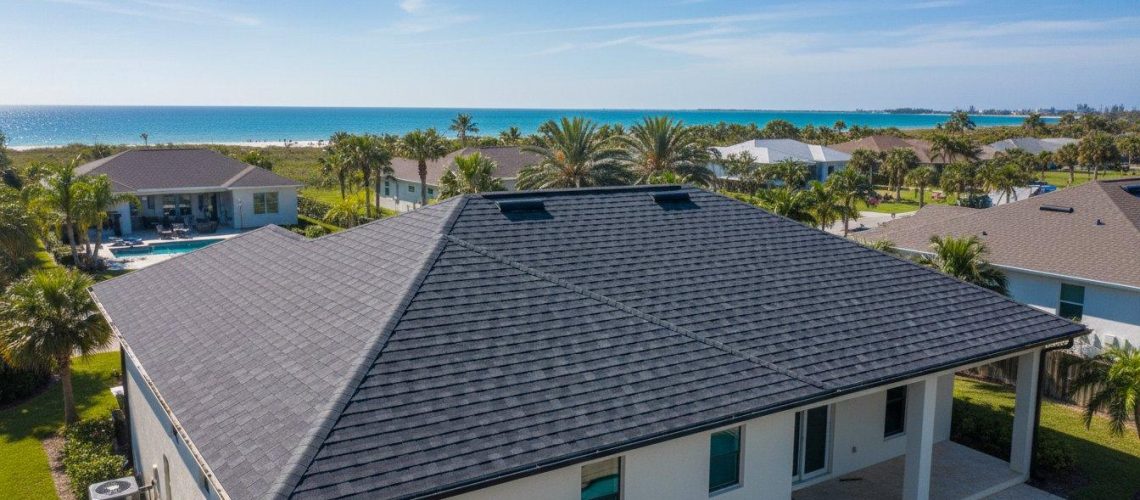

Did you know that the wind portion of your Florida homeowner’s insurance premium can account for up to 70% of your total bill? For many Pinellas County families, properly documenting structural defenses can slash those skyrocketing costs by 20% to 50%. It’s a significant financial relief that starts with understanding the latest Pinellas County wind mitigation roof requirements. We know how stressful it is to watch premiums rise while worrying if your roof deck can handle the next major Gulf storm. It’s frustrating to deal with confusing “In-Progress” inspection rules when you just want to keep your home safe and your budget intact.
At Rainier Roofing LLC, we’ve served as guardians of the family home since 1987. We believe you deserve a roof that offers maximum protection and an insurance process that’s completely worry-free. This guide will help you navigate the new OIR-B1-1802 inspection form required as of April 1, 2026. You’ll learn how to leverage the 25% Rule in the current building code and secure the “Rainier Difference” for your property. We’ll show you exactly how to pass your wind mitigation inspection on the first try, ensuring your home is ready for the 2026 hurricane season and your wallet is protected from unnecessary surcharges.
Key Takeaways
- Discover how meeting the latest Pinellas County wind mitigation roof requirements can lower your insurance premiums by 20% to 50% while stabilizing your long-term housing costs.
- Learn why a Secondary Water Barrier (SWR) is the gold standard for protecting your roof deck from hurricane-force rain and securing maximum policy credits.
- Master the documentation needed for the new 2026 OIR-B1-1802 form to ensure your wind mitigation inspection passes on the very first visit.
- Understand the critical role of “In-Progress” inspections and why hiring a PCCLB-verified contractor is essential for legal and structural compliance in Pinellas County.
- Explore how GAF WindProven systems with LayerLock Technology create a “worry-free” shield against the unique climate challenges of the Tampa Bay area.
What is Wind Mitigation and Why is it Critical in Pinellas County?
Wind mitigation is a set of specific structural reinforcements designed to harden your home against hurricane-force winds. In our community, meeting the Pinellas County wind mitigation roof requirements isn’t just about following the law; it’s about ensuring your family stays safe when a major storm rolls in from the Gulf. Since 1987, Rainier Roofing LLC has seen how these standards prevent catastrophic roof failure and protect the structural integrity of the entire house. The primary goal is simple: keeping your roof attached to the walls. High-velocity winds create massive uplift pressure that can peel back shingles or lift an entire roof deck. The 8th Edition of the Florida Building Code, which remains the active standard in mid-2026, mandates these protections to stabilize our local housing market and keep insurance accessible for everyone.
The 2026 Pinellas Coastal Environment
St. Petersburg and Clearwater face unique environmental challenges that require specialized expertise. While Pinellas isn’t officially classified in the High Velocity Hurricane Zone like Miami-Dade, our coastal wind speeds often require engineering that parallels those strict standards. The updated ASCE 7-22 wind zone designations now used in 2026 inspection forms require precise data on local wind pressure. Our constant salt air and high humidity also demand high-integrity materials that won’t corrode. If your roof isn’t built to handle these specific 2026 code updates, the wind and moisture can cause hidden damage long before a storm even arrives. We’ve spent decades studying these micro-climates to ensure our neighbors receive the best possible protection.
Wind Mitigation vs. Standard Roofing
A standard roof replacement focuses on aesthetics and basic leak protection, but a mitigated roof goes much further. It involves specific extra steps, such as enhanced deck nailing and the installation of a secondary water barrier, that aren’t always included in a “basic” quote. You might wonder, What is a Wind Mitigation Inspection? Essentially, it’s a certified review of these features to prove to your insurer that your home is a lower risk.
As of April 1, 2026, all inspectors must use the new OIR-B1-1802 form. This document requires more rigorous data collection, including permit dates and photographic evidence of the roof’s internal components. If you don’t meet the Pinellas County wind mitigation roof requirements during the construction phase, you’ll likely miss out on insurance credits that could save you thousands of dollars over the life of your roof. Rainier Roofing LLC provides the comprehensive documentation you need to ensure your home qualifies for every available discount while providing the peace of mind that comes with a job done right.
Key Technical Requirements for Pinellas Roof Mitigation
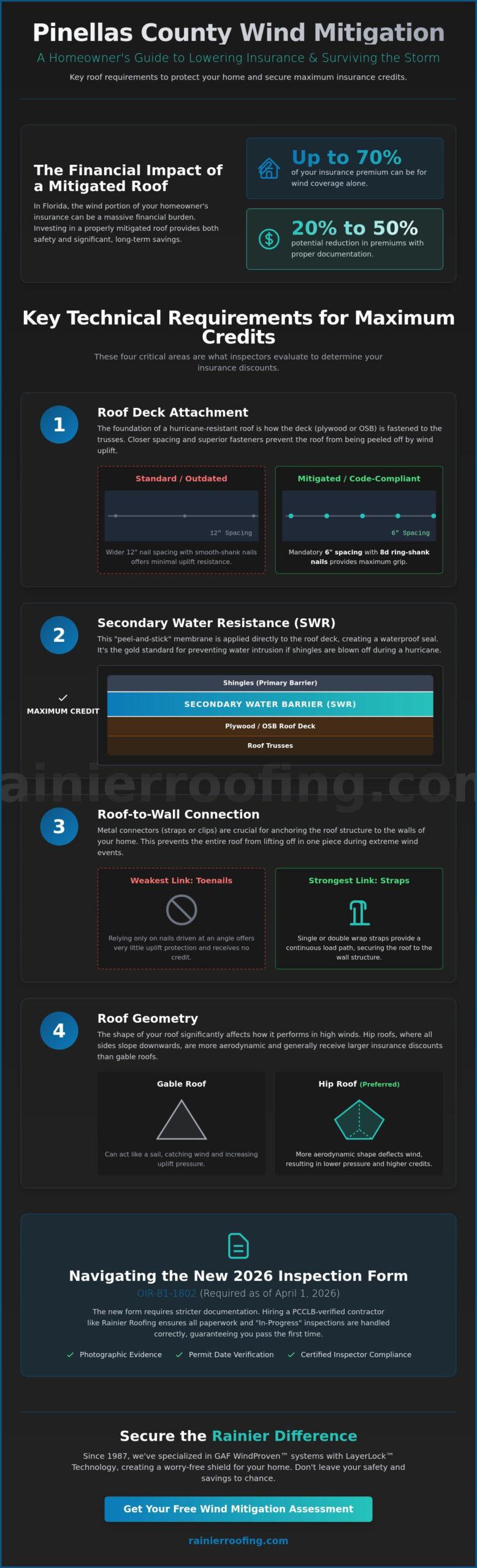
Building a roof that stands up to a major Gulf storm requires more than just new shingles. It requires a commitment to structural integrity that starts at the deck. To meet the Pinellas County wind mitigation roof requirements, we focus on four critical areas: how the deck is attached, how water is kept out if shingles fail, how the roof connects to your walls, and the physical shape of the structure itself. These technical details are exactly what inspectors look for when filling out the official wind mitigation forms required by Florida insurers. Since 1987, we’ve refined our process to ensure every nail and layer of underlayment provides maximum protection for your family.
Enhanced Nailing Patterns and Fasteners
The strength of your roof starts with the fasteners holding the plywood deck to the rafters. Standard construction often used 12-inch nail spacing, but current codes for high-wind areas require a much tighter 6-inch spacing along the edges and in the field. We don’t just use more nails; we use better ones. Smooth-shank nails can pull out under the intense suction of hurricane winds. Instead, we utilize ring-shank nails, which feature small ridges that grip the wood like a screw. For 2026 building codes, the 8d ring-shank nail is the mandatory fastener required to achieve the highest uplift resistance ratings. This small change in hardware makes a massive difference in whether your roof stays put during a storm.
Secondary Water Resistance (SWR) Requirements
In Pinellas County, it’s not a matter of if you’ll face heavy rain, but when. A Secondary Water Barrier (SWR) acts as a final shield for your home’s interior. While some contractors use taped seams over felt paper, Clearwater homeowners see the best results with self-adhered modified bitumen, commonly known as peel-and-stick underlayment. This material bonds directly to the roof deck, creating a watertight seal that remains intact even if your shingles are blown away. This layer is a primary category on the 2026 inspection form and often triggers significant insurance credits. If you’re planning a project, you can consult with our team to see which SWR solution fits your home’s specific geometry.
Roof-to-wall connections and roof geometry also play vital roles in your final mitigation score. Inspectors check for metal clips or wraps that anchor your rafters to the wall studs, preferring double wraps for the highest level of security. Additionally, homeowners with hip roofs, where all sides slope down toward the walls, often receive higher credits because this shape naturally deflects wind pressure better than gable roofs. By addressing these technical requirements during a re-roof, you aren’t just passing an inspection; you’re investing in the long-term longevity of your property.
The Insurance Connection: How Mitigation Saves Pinellas Homeowners Money
Your roof is the first line of defense against a storm, but it is also the primary factor in determining your home insurance costs. In 2026, Florida’s insurance market remains challenging, and many carriers now require proof that you meet specific Pinellas County wind mitigation roof requirements before they will even issue a new policy. A passing wind mitigation report does more than just satisfy a checklist; it directly triggers mandatory premium credits. Because the wind portion of your insurance bill can account for up to 70% of your total premium, the savings are substantial. Properly documented structural upgrades can reduce that windstorm portion by 20% to 50%, providing long-term financial stability for your household.
Calculating your return on investment is straightforward when you look at these annual savings. While the initial cost of upgrades like secondary water barriers or enhanced nailing might seem like an added expense, these features often pay for themselves through premium reductions within just a few years. Beyond the immediate credits, you’re also protecting your home’s resale value. A roof that is fully compliant with 2026 standards is a major selling point in St. Petersburg and Clearwater, offering peace of mind to future buyers who are equally concerned about insurance availability and storm safety.
Understanding the Wind Mitigation Inspection Report
The new OIR-B1-1802 form, required for all inspections after April 1, 2026, breaks your roof down into seven key categories. One of the most impactful for your wallet is the “Roof Deck Attachment” section. If your contractor utilized the 6-inch nail spacing and 8d ring-shank nails we discussed earlier, you qualify for “Level A” or “Level B” credits. These are the highest possible ratings for deck attachment. Additionally, while any roof permitted after the 2001 Florida Building Code receives a baseline credit, the 2026 form requires much more granular detail to unlock maximum discounts. You can find more resources on these financial incentives through the My Safe Florida Home Program, which helps homeowners harden their properties against storm damage.
Maximizing Your Insurance Credits
To get the most out of your inspection, your roof must work in tandem with other structural features. For instance, “Opening Protection” like hurricane shutters or impact-rated glass works with your roof to maintain the structural “envelope” of the house. Inside the attic, the difference between “Clips” and “Toenails” is a major financial pivot point. Standard toenailing offers minimal resistance, while metal clips that wrap over the rafter provide the robust connection insurers want to see. Once your project is finished, we ensure you have a signed mitigation affidavit to present to your insurance agent. This document serves as your professional proof of craftsmanship and integrity, ensuring your St. Pete home is recognized as a low-risk property.
Navigating the Pinellas County Inspection and Affidavit Process
Completing a roof replacement in St. Petersburg or Clearwater requires a specific sequence of inspections to ensure your home meets legal standards. Selecting a licensed contractor verified by the Pinellas County Construction Licensing Board (PCCLB) is your first critical step. Active county-certified contractors must renew their credentials by September 30 each year, ensuring they remain current on local ordinances. If you’re repairing storm damage from previous seasons, remember that penalties for after-the-fact permits are waived through June 30, 2026, though standard fees still apply. Following the proper sequence ensures you meet all Pinellas County wind mitigation roof requirements without facing costly delays or permit failures.
Once your contractor begins the work, the process moves through several mandatory checkpoints. These aren’t just bureaucratic hurdles; they’re your guarantee that the structural “Rainier Difference” is actually built into your home. From verifying the 8d ring-shank nails to checking the secondary water barrier, each step must be visible to the authorities. After the county permit is closed, your final task is hiring a third-party inspector to complete the insurance verification form. This professional ensures your structural upgrades translate into the premium credits you deserve.
The ‘In-Progress’ Inspection Rule
Pinellas County mandates an ‘In-Progress’ inspection, often called the dry-in inspection. This must occur after the old roof is removed and the new underlayment and deck fasteners are installed, but before the shingles cover them up. Inspectors must physically see the 6-inch nail spacing to certify the roof’s uplift resistance. If a contractor covers the deck before this inspection, the county may require shingles to be removed, or they might deny the final permit. Rainier Roofing LLC manages this schedule tightly, ensuring the inspector arrives exactly when the deck is ready so your home isn’t left exposed to the elements for longer than necessary.
The Re-Roofing Mitigation Affidavit
The Re-Roofing Mitigation Affidavit is a legal document where your contractor certifies that the non-visible components of your roof meet the 8th Edition Florida Building Code. This includes the deck attachment and the secondary water barrier. While Pinellas County updated its rules so that photos are no longer strictly required with the affidavit, we believe in total transparency. We continue to document every stage of the process with high-resolution photography to give you and your insurance company undeniable proof of craftsmanship. You must post this affidavit, along with a shingle wrapper from the materials used, at the job site for the final county walk-through. If you want a team that handles every detail of this complex paperwork, contact Rainier Roofing LLC for a detailed project estimate.
The Rainier Difference: GAF WindProven Systems for Pinellas Homes
Choosing the right materials is the final step in securing your home against the unpredictable Gulf weather. At Rainier Roofing, we’ve protected our neighbors since 1987 by selecting products that don’t just meet the minimum Pinellas County wind mitigation roof requirements but actively exceed them. We recommend the GAF Timberline HDZ shingle system because it’s engineered for the high-pressure environments common in St. Petersburg and Clearwater. When combined with our professional installation, these shingles provide the structural integrity your family deserves. We position ourselves as guardians of your property, ensuring that your investment provides both maximum protection and long-term financial security through lower insurance costs.
Beyond Code: GAF Timberline HDZ and WindProven
The secret to surviving a major storm lies in the precision of the installation. GAF’s LayerLock Technology creates the industry’s largest strike zone, which is a specialized nailing area that ensures every fastener hits the common bond between shingle layers. This is critical for achieving the 6-inch nail spacing we discussed earlier. When our team utilizes this technology, we create a mechanically fused bond that offers incredible uplift resistance. This level of craftsmanship is why we can offer the GAF WindProven Limited Wind Warranty. It’s the first of its kind with no maximum wind speed limitation, provided we install the shingles with four qualifying GAF accessories like starter strips and ridge caps.
Most standard shingles are only rated for 110 mph or 130 mph, but the WindProven system is designed to stay intact even when wind speeds climb higher. This exceeds the 130 mph requirements often cited in local codes, giving you an extra layer of “worry-free” security. To unlock these elite warranties, you must work with a certified professional. As a GAF Master Elite roofer Tampa homeowners trust, we are among the top 2% of contractors nationwide authorized to provide these protections. This certification is your proof of our integrity and our commitment to using high-trust materials that stand the test of time.
Why Choose a Local Pinellas Expert?
Navigating the building departments in St. Pete and Clearwater requires more than just technical skill; it requires decades of local experience. We’ve spent over 35 years building relationships with Pinellas County inspectors and staying ahead of shifting ordinances. We understand that your home is your most valuable asset, and we treat every project with the steady, methodical pace that high-quality construction demands. Our “Guardian” approach means we handle the stress of the 2026 code updates so you don’t have to. We ensure your permit is closed correctly, your affidavit is filed, and your home is ready for the next hurricane season. If you’re ready to secure your premium credits and protect your roof deck, contact Rainier Roofing for a free wind mitigation inspection and let us show you the Rainier Difference.
Secure Your Home and Savings for the 2026 Storm Season
Protecting your property from the unpredictable Gulf environment is a commitment to your family’s long-term security. By meeting the current Pinellas County wind mitigation roof requirements, you aren’t just hardening your home against hurricane-force winds; you’re also positioning yourself for insurance premium credits of up to 50%. The transition to the 2026 OIR-B1-1802 inspection form makes professional documentation more critical than ever. Whether it’s the precision of 6-inch deck nailing or the watertight seal of a secondary water barrier, these structural details define your home’s resilience.
Since 1987, Rainier Roofing has served as a guardian for local homeowners. We bring over 15 years of specialized Florida storm experience and a GAF Master Elite certification to every project. Our A+ rating for wind mitigation compliance ensures your roof passes inspection on the first try. Don’t leave your insurance costs or your safety to chance.
Get Your Free Pinellas County Roof Inspection & Wind Mitigation Quote
We’re ready to help you navigate these codes with integrity and professional care. Let’s ensure your home remains a worry-free sanctuary for years to come.
Frequently Asked Questions
Is a wind mitigation inspection required by law in Pinellas County?
A wind mitigation inspection is not legally required by Florida law, but most insurance carriers in Pinellas County mandate one before issuing or renewing a policy. While the state doesn’t force you to get the inspection, the Florida Building Code requires specific mitigation features during any re-roofing project. These features ensure your home meets safety standards even if you choose not to file for the insurance credits.
How much can I save on my insurance with a wind mitigation report?
You can save between 20% and 50% on the windstorm portion of your insurance premium with a valid report. In Florida, the wind portion can represent up to 70% of your total bill, so these credits are substantial. The exact amount depends on the specific defenses your roof has, such as “Level A” deck attachment or a secondary water barrier installed by a professional.
What is the ‘In-Progress’ inspection for roofing in Pinellas?
The ‘In-Progress’ inspection is a mandatory check by county officials that occurs after the old shingles are removed and the new deck fasteners are installed. This allows the inspector to verify that the 6-inch nail spacing and underlayment meet the latest Pinellas County wind mitigation roof requirements. If you skip this step and cover the deck with shingles, the county may deny your final permit and insurance credits.
Does a new roof automatically pass a wind mitigation inspection?
A new roof does not automatically guarantee a “passing” score for maximum insurance credits. While every new roof must meet the 8th Edition Florida Building Code, the inspector needs specific proof of features like the type of nails used and the presence of a secondary water barrier. If your contractor didn’t document these hidden components or use the right materials, you might miss out on the highest credit tiers.
What is the Re-Roofing Mitigation Affidavit?
The Re-Roofing Mitigation Affidavit is a legal document where your licensed contractor certifies that the roof deck attachment and underlayment meet state standards. Since these components are hidden once shingles are installed, this affidavit serves as the official record for the county. It must be signed and posted at the job site before the final building inspection can be successfully completed.
Can I perform my own wind mitigation inspection for insurance?
You cannot perform your own inspection for insurance purposes. Florida law requires these inspections to be completed by a licensed building inspector, architect, engineer, or a certified contractor. To ensure your 2026 OIR-B1-1802 form is accepted by your carrier, you must hire a qualified third-party professional who is trained to identify and document structural wind resistance features accurately.
What roof shape is best for wind mitigation credits?
A hip roof is the best shape for securing maximum wind mitigation credits. This design, where all sides of the roof slope down toward the walls, naturally deflects wind pressure and reduces uplift during a storm. Insurance companies view hip roofs as lower risk than gable roofs, which have vertical ends that can catch the wind like a sail and lead to structural failure.
How long is a wind mitigation inspection valid in Florida?
A wind mitigation inspection is typically valid for five years from the date it was performed. However, if you replace your roof or make significant structural changes before that window ends, you’ll need a new inspection to reflect the updated Pinellas County wind mitigation roof requirements. Keeping your report current ensures you don’t lose out on valuable premium discounts as your policy renews each year.